
Recently Added
Stalking Prevention, Awareness, and Resource Center (SPARC)
Fact sheet: Stalking & Firearms (Spanish)
A fact sheet (in Spanish) highlighting how possession and use of firearms can be used during a stalking course of conduct and considerations for risk assessment and safety planning when firearms are accessible to the perpetrator.
Stalking Prevention, Awareness, and Resource Center (SPARC)
Discussion Guide: “YOU” Seasons 1-4 Recap
A guide outlining potential discussion questions and activities on seasons 1-3 of the Netflix television show “You” in anticipation of the fifth and final season.
Stalking Prevention, Awareness, and Resource Center (SPARC)
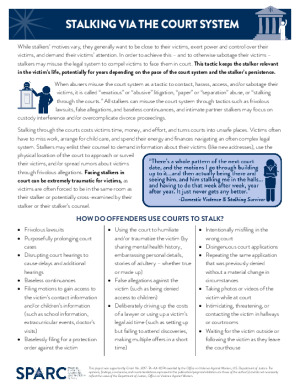
Judicial Officer Reminder: Stalking Behaviors
This two-page resource is designed for use in conjunction with the more comprehensive Judicial Officer Guide for Responding to Stalking and as a reference when considering the role of stalking in Federal courts; Tribal courts; immigration courts; state family, juvenile, civil, and criminal court cases; and administrative law adjudications including immigration and Equal Employment Opportunity Commission adjudications. Judicial officers are strongly encouraged to read the full Guide prior to using this reminder resource during proceedings. This reminder sheet serves as a reference for judicial officers on stalking behaviors and how these behaviors relate to other crimes, to be better able to identify stalking in any type of case. Judicial officers are encouraged to make specific findings of fact regarding stalking and issue detailed orders designed to stop stalking behaviors, hold offenders accountable, and prevent dangerous consequences.
Stalking Prevention, Awareness, and Resource Center (SPARC)
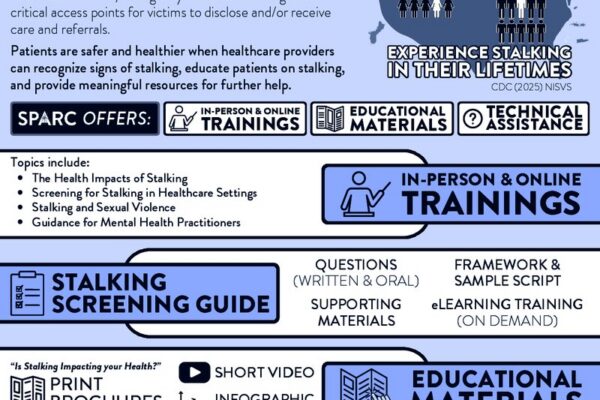
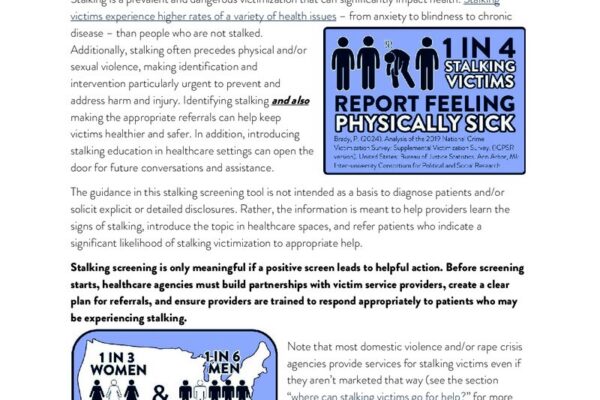
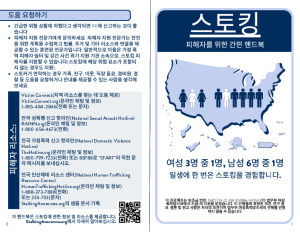
Infographic: Stalking & Health Impacts
An infographic highlighting the physical and mental health impacts on stalking victims/survivors
National Network to End Domestic Violence
Teens and Tech Toolkit: Warning Signs with Online Dating
Battered Women’s Justice Project
Understanding The Difference Between a Domestic Violence Protection Order (DVPO) And an Extreme Risk Protection Order (ERPO)
A domestic violence protection order (DVPO) is issued by a court to protect a survivor of family or intimate partner abuse/violence and requires the person subject to the order to do, or not do, certain actions. DVPOs can protect the survivor in many ways, including: ordering the respondent from coming near the survivor or their home or workplace, from communicating with the survivor, providing for custody or visitation, provisions related to housing, express prohibitions against further harassment, threats, stalking or other abusive behaviors against the survivor and their children. DVPOs can also prohibit the respondent from accessing firearms or ammunition during the time the DVPO is in effect. All U.S. states and territories have laws providing for DVPOs.
As of late 2024, 21 U.S. states and Washington, D.C. have laws providing for extreme risk protection orders (ERPO), a court order that requires the person subject to the order to turn in firearms and ammunition in their possession and can prohibit the respondent from purchasing firearms and ammunition while the order is in effect.
It is important for survivors to have access to information about the differences between these legal tools.
Battered Women’s Justice Project
A Brief History and Framework of Federal Firearms Laws Addressing Intimate Partner Violence
Federal law provides a framework to keep guns out of the hands of those who perpetrate domestic violence. Those laws can be complex to understand. This resource provides a basic explanation of the current federal firearms laws that address intimate partner violence, how those laws triggered and how they interact.
Battered Women’s Justice Project
Research at the Intersection of Intimate Partner Violence and Firearms
Prevalence rates of both intimate partner violence and gun violence remain pervasive. Research demonstrates a lethal association when intimate partner violence and firearms are combined.
Battered Women’s Justice Project
The New Misdemeanor Dating Violence Federal Firearms Prohibitor: An FAQ for Victim Advocates
This resource explains what changes the Bipartisan Safer Communities Act made to narrow the so-called “boyfriend loophole,” how “dating relationships” are defined by this law, and how victim advocates can support survivors whose current or former dating partners may have access to, or be prohibited from accessing, firearms.
Battered Women’s Justice Project
State Statutes on Firearm Relinquishment in Cases Involving Intimate Partner Violence
This chart includes information about state laws that speak to expressly authorized or
mandated firearm relinquishment orders in civil protection order and criminal cases involving intimate partner violence. The information is current as of September 2024, may not be all-inclusive, and is intended only for educational and research purposes. State statutes are constantly changing. Additionally, the absence of statutory provisions related to relinquishment does not mean state and local authorities lack the authority to implement relinquishment processes.