
Recently Added
Conducting Legal Intakes with LGBTQ+ Survivors
Attorneys for survivors of domestic violence, dating violence, sexual assault, and stalking can develop trust… Read more
Stalking Prevention, Awareness, and Resource Center (SPARC)
Responding to Military-Connected Survivors of Stalking
Stalking Prevention, Awareness, and Resource Center (SPARC)
Mental Health Professionals’ Guide to Supporting Clients Experiencing Stalking
Stalking Prevention, Awareness, and Resource Center (SPARC)
Listening for Stalking in Mental Health Settings
Stalking Prevention, Awareness, and Resource Center (SPARC)
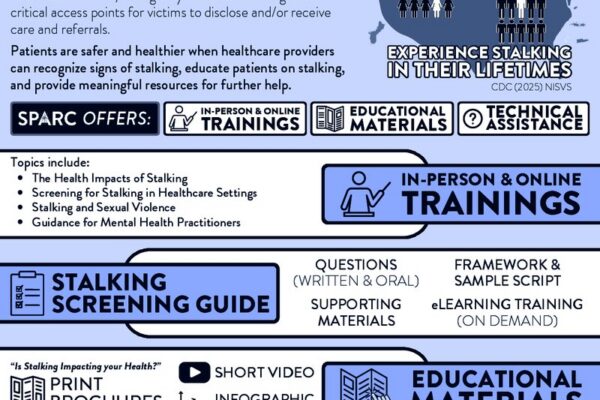
Guide to Screening for Stalking in Healthcare Settings
Stalking Prevention, Awareness, and Resource Center (SPARC)
Talking Stalking: Tips for Campus Public Awareness Campaigns
This guide includes strategies to incorporate stalking education into existing SA and DV programming on college campuses; resources for workshops specifically focused on stalking; and activities, videos, and other resources that can serve as building blocks for your own program.
Stalking Prevention, Awareness, and Resource Center (SPARC)
Supporting LGBTQ+ Stalking Victims: A Guide for Victim Advocates
This Guide is for victim advocates working with lesbian, gay, bisexual, transgender, and queer (LGBTQ+) individuals who may be experiencing stalking. Other service providers, individuals experiencing stalking, and friends/family of people experiencing stalking may also find it useful in supporting victims of stalking. It provides basic information about the dynamics of stalking and safety planning, co-occurring crimes, specific tactics used against LGBTQ+ individuals, safety planning strategies that support LGBTQ+ stalking victims, and issues to be aware of when supporting LGBTQ+ victims.
Stalking Prevention, Awareness, and Resource Center (SPARC)
Stalking: A Short Handbook for Victims (Vietnamese)
Stalking Prevention, Awareness, and Resource Center (SPARC)
Stalking: A Short Handbook for Victims (Tagalog)

Understanding the Counterman v. Colorado Supreme Court Decision
This document breaks down the Counterman v. Colorado case and goes back to basics to make sure stakeholders understand what the Supreme Court decided – and what that decision may mean for stalking prosecutions moving forward. This document is intended as a general explainer.

Ten Strategies for Prosecuting Child Sexual Abuse at the Hands of a Family Member
Stalking Prevention, Awareness, and Resource Center (SPARC)
Technology-Facilitated Stalking Behaviors
Nearly half of all stalking cases involve both in-person and technology-facilitated stalking. In fact, many offenders combine their technology abuse activities with in-person forms of stalking and harassment. Discuss the list in this guide with a victim to identify what technology-facilitated stalking behaviors they are experiencing, how to best document that the behaviors are happening, and plan for their safety.
Stalking Prevention, Awareness, and Resource Center (SPARC)
Law Enforcement Guide: Responding to Stalking
This Guide is for law enforcement officers and agencies regarding their response to stalking. It also provides basic information about the dynamics of stalking, strategies to identify and investigate the crime, and important components of appropriate agency response.
Stalking Prevention, Awareness, and Resource Center (SPARC)
Law Enforcement Agency Model Policy: Stalking Response
This resource is a descriptive model policy of best practices for the effective law enforcement response to and investigation of stalking. As a complex crime, stalking deserves a comprehensive policy as well as appropriate training for all agency employees. Depending on an agency’s size, organization, and resources, some pieces of this model policy may need to be renamed or combined. Careful consideration is encouraged before removing any pieces of this model policy.

Stalking Prevention, Awareness, and Resource Center (SPARC)
Judicial Officer Guide: Responding to Stalking
This Judicial Guide is designed to work in conjunction with federal, state, Tribal, and territorial stalking laws. Judicial officers should consider stalking in all types of legal proceedings, including in Federal courts; Tribal courts; immigration courts; state family, juvenile, civil, and criminal court cases; and administrative law adjudications including immigration and Equal Employment Opportunity Commission adjudications. Judicial officers can use this tool to:
- Help identify the patterns and behaviors of stalking;
- Provide courts the background needed to readily identify stalking patterns and behaviors; and
- Include findings regarding stalking, using model judicial order language, in court orders.