
Recently Added

Attorney Safety Guide
Attorneys who work on cases involving domestic and dating violence, sexual assault, and stalking (DVSAS)… Read more

Battered Women’s Justice Project
Court Practice in Domestic Violence Protection Order Cases: Creating Court Summary Information Forms
Because protection orders can be the basis by which someone is ineligible to receive a… Read more

Battered Women’s Justice Project
Court Practice in Misdemeanor Crimes of Domestic and Dating Violence Cases: Creating Court Summary Information Forms
Because misdemeanor convictions for crimes of domestic and dating violence can be the basis by… Read more
Battered Women’s Justice Project
U.S. v. Rahimi: Understanding the Implications for Protection Orders and Firearms Prohibitions
In June 2024, the U.S. Supreme Court upheld the federal law that prohibits domestic abusers… Read more

Battered Women’s Justice Project
What High Schools and Colleges Need to Know About Dating Violence and Firearms
In the United States, one in eight high school students reports having been subjected to… Read more

Increasing Collaboration between Criminal and Civil Courts in Domestic Violence Cases: Best Practices for Increasing Access to Justice
Litigants involved in domestic violence cases often report being overwhelmed by the legal process – when the same incident gives rise to simultaneous cases in civil and criminal court, litigants may be shuffled between multiple courtrooms and courthouses. In order to support victim safety and meaningful accountability, court systems should work towards providing a holistic, coordinated response based on comprehensive information about all legal cases involving the parties before them. This fact sheet provides considerations for assessing current practice and designing new strategies for strengthening coordination.

Battered Women’s Justice Project
Increasing Your Safety: Full Faith and Credit for Protection Orders
‘Increasing Your Safety: Full Faith and Credit for Protection Orders’ is a National Center on Protection Orders and Full Faith & Credit resource guide for survivors.

Integrating Procedural Justice in Domestic Violence Cases: A Practice Guide
This guide is designed to help courts and domestic violence stakeholders assess their current practices and integrate new strategies to enhance procedural justice. The materials in this guide are based upon promising practices identified through both the Center for Court Innovation’s operating programs and national training and technical assistance.
National Network to End Domestic Violence
Intermediarios de datos: Que son y que puede hacer con respecto a ellos
El recurso explica los riesgos para la privacidad de los sobrevivientes publicados por los intermediarios de datos y las diferentes estrategias potenciales para abordar este problema en la planificaci?n de la privacidad. Es una revisi?n del recurso anterior sobre corredores de datos y contiene contenido nuevo. El p?blico objetivo son los sobrevivientes y los proveedores de servicios para v?ctimas.
National Center for State Courts
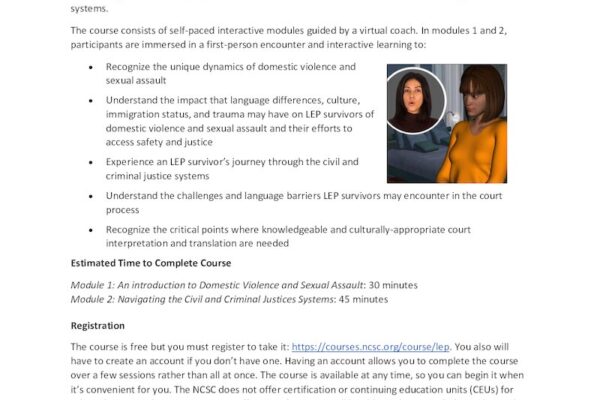
Interpreting for Domestic Violence and Sexual Assault Cases
This introductory course seeks to equip court and legal interpreters with fundamental knowledge and insights about domestic violence and sexual assault that will enhance their ability to help LEP survivors make their voices heard. Interpreting for Domestic Violence and Sexual Assault Cases consists of two self-paced interactive modules (generally 20-45 minutes in length) guided by a virtual coach.
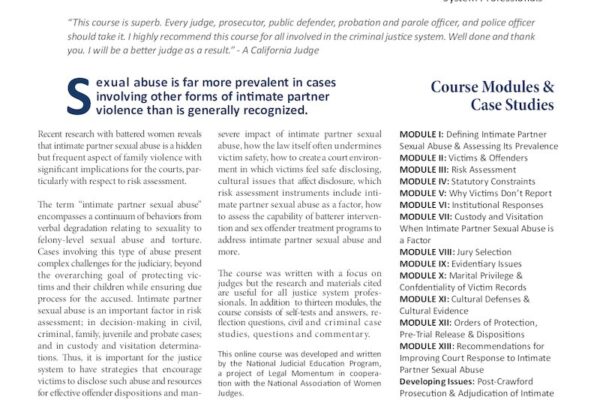
Intimate Partner Sexual Abuse: Adjudicating this Hidden Dimension of Domestic Violence Cases
This resource is a flyer that describes the National Judicial Education Program’s web course “Intimate Partner Sexual Abuse: Adjudicating this Hidden Dimension of Domestic Violence Cases.” The web course provides comprehensive education resource about the nature, prevalence and impact of intimate partner sexual abuse that is intended to inform courts’ response to this issue in whatever type of proceeding it arises. In addition to thirteen modules, the course consists of self-tests and answers, reflection questions, civil and criminal case studies, questions and commentary. While the web course was written with a focus on judges, the research and materials cited are useful for all justice system professionals.
Battered Women’s Justice Project
Intimate Partner Violence and Combat Experience
A guide for advocates talking with victims of IPV whose partners have combat experience and may have other co-occurring conditions.

Invisible Pain and Overlooked Violence: Abusive Partner Interventions in the LGBTQIA Community
This document will provide a framework to better understand intimate partner violence that occurs within LGBTQIA+ relationships and highlight strategies specifically for abusive partner intervention programs working with LGBTQIA+ people who have caused harm as a means to gain and maintain power and control over their intimate partner.

Judges Tell: What I Wish I Had Known Before I Presided in an Adult Victim Sexual Assault Case
Sexual assault cases present unique challenges. They are beset with a myriad of deeply held stereotypes and misconceptions that can undermine the judicial process. To assist new judges, NJEP canvassed judges across the country who had attended NJEP programs to ask what these judges wished they had known before they presided in an adult victim sexual assault case, or a case of co-perpetrated sexual abuse and domestic violence. Judges Tell presents these judges’ twenty-five points followed by commentary and sources. This resource is a great primer on the realities of sexual assault cases for members of any profession.

Judicial Officer Bench Card: Stalking
This bench card is designed for use in conjunction with the more comprehensive Judicial Officer Guide for Responding to Stalking and as a reference when considering the role of stalking in Federal courts; Tribal courts; immigration courts; state family, juvenile, civil, and criminal court cases; and administrative law adjudications including immigration and Equal Employment Opportunity Commission adjudications. Judicial officers are strongly encouraged to read the full Guide prior to using this bench card during proceedings. This bench card serves as a reference for judicial officers on stalking behaviors and how these behaviors relate to other crimes, to be better able to identify stalking in any type of case. Judicial officers are encouraged to make specific findings of fact regarding stalking and issue detailed orders designed to stop stalking behaviors, hold offenders accountable, and prevent dangerous consequences.