
Recently Added
Stalking Prevention, Awareness, and Resource Center (SPARC)
Responding to Military-Connected Survivors of Stalking
Stalking Prevention, Awareness, and Resource Center (SPARC)
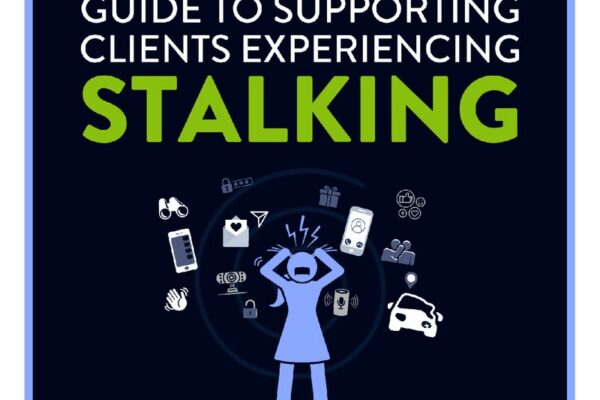
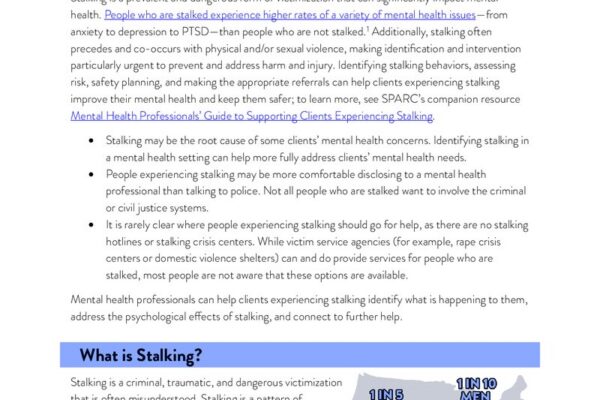
Mental Health Professionals’ Guide to Supporting Clients Experiencing Stalking
Stalking Prevention, Awareness, and Resource Center (SPARC)
Listening for Stalking in Mental Health Settings
Stalking Prevention, Awareness, and Resource Center (SPARC)
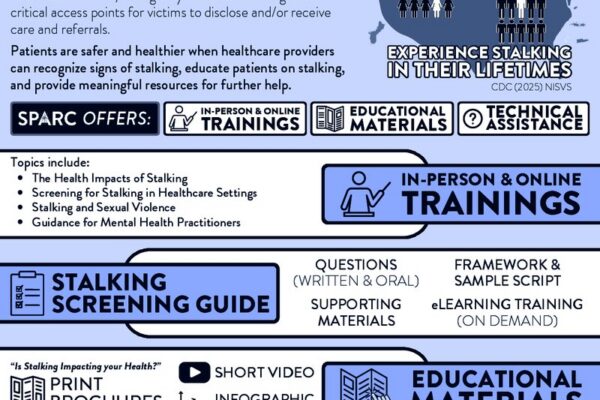
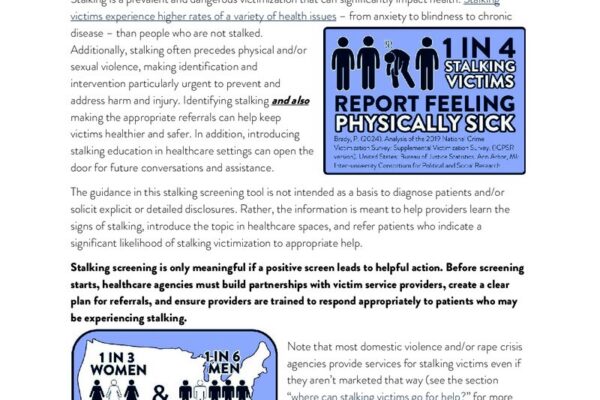
Guide to Screening for Stalking in Healthcare Settings
Stalking Prevention, Awareness, and Resource Center (SPARC)
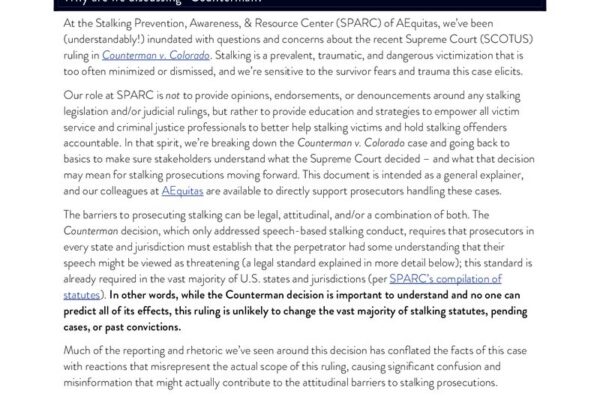
Understanding the Counterman v. Colorado Supreme Court Decision
Ladies Empowered with Resources
Module 2: Understanding Trauma Responses in Entrepreneurship
Module 2: Understanding Trauma Responses in Entrepreneurship Video Presentation
Module 2 of the Empowering Survivor Entrepreneurs initiative developed by Ladies Empowered with Resources focuses on recognizing and understanding trauma responses within entrepreneurship and economic empowerment environments.
This training helps providers, advocates, coaches, and support professionals identify how trauma may influence business participation, emotional regulation, communication patterns, trust, self-worth, motivation, burnout, fear of visibility, perfectionism, avoidance, financial behaviors, and decision-making.
Participants explore common trauma responses including fight, flight, freeze, fawn, hypervigilance, shutdown, and survival-based coping behaviors that may appear during entrepreneurship development. The module also introduces strategies for creating emotionally safer entrepreneurship spaces that reduce re-traumatization and increase engagement, empowerment, flexibility, and long-term sustainability.
Through practical examples, reflective exercises, implementation tools, and survivor-centered approaches, participants gain a deeper understanding of how trauma-informed entrepreneurship support can strengthen survivor engagement and organizational responsiveness.
This training is designed for transitional housing providers, victim service professionals, community advocates, entrepreneurship coaches, workforce development staff, faith-based organizations, social service agencies, and multidisciplinary professionals supporting survivors of domestic violence, sexual assault, dating violence, stalking, human trafficking, economic abuse, and other traumatic experiences.
Materials may be used for educational and implementation support purposes.
Ladies Empowered with Resources
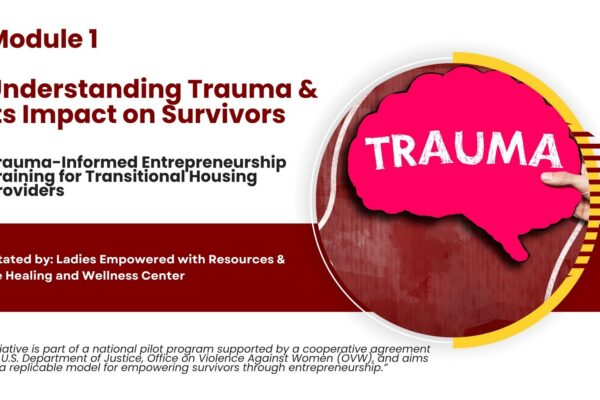
Module 1: Foundations of Trauma-Informed Entrepreneurship
Module 1: Foundations of Trauma-Informed Entrepreneurship Video Presentation
Module 1 serves as the introductory training within the Empowering Survivor Entrepreneurs initiative developed by Ladies Empowered with Resources (LEWR). This module explores the intersection of trauma-informed care and entrepreneurship education, helping providers understand how trauma can influence entrepreneurial journeys, business engagement, self-confidence, emotional regulation, and long-term sustainability.
The training introduces foundational trauma-informed principles including safety, trustworthiness, peer support, collaboration, empowerment, cultural responsiveness, and survivor-centered engagement within entrepreneurship settings.
Participants are guided through practical examples, reflective activities, and implementation strategies designed to help organizations create safer and more supportive entrepreneurship environments for survivors.
This module is intended for transitional housing providers, victim service organizations, workforce development professionals, entrepreneurship coaches, advocates, case managers, faith-based organizations, and multidisciplinary professionals supporting survivors of trauma, domestic violence, sexual assault, dating violence, stalking, or economic abuse.
Materials may be used for educational and implementation support purposes.
National Alliance to End Sexual Violence
Reframing Services: Prioritizing the Housing Needs of Survivors of Sexual Assault
This webinar recording elevates why housing is a priority area for survivors of sexual assault, discusses key findings from a series of listening sessions hosted by the National Sexual Assault Housing Collaborative, and shares recommendations to better address the housing needs of survivors of sexual assault.
National Network to End Domestic Violence
Seguridad y Privacidad con el WiFi: Sugerencias para Agencias de Servicios para Víctimas y Sobrevivientes
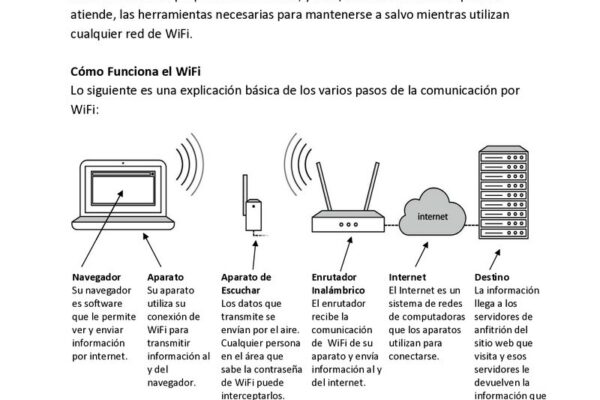
El acceso a WiFi se ha vuelto tan común que muchos lugares públicos cuentan con redes y puntos de acceso a los que usted puede conectarse. Pero, simplemente el hecho de que una red está disponible no significa que sea segura. La información a continuación les proporcionará a usted, y a los/las sobrevivientes a quienes atiende, las herramientas necesarias para mantenerse a salvo mientras utilizan cualquier red de WiFi.
National Network to End Domestic Violence
WiFi Safety & Privacy: Tips for Victim Service Agencies & Survivors WiFi Safety
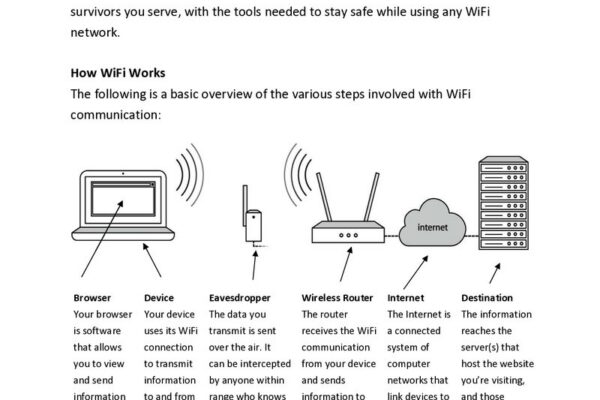
WiFi access has become so commonplace that many public places have networks and hotspots that you can connect to. But just because a network is available doesn’t mean it is secure. The information below will provide you, and the survivors you serve, with the tools needed to stay safe while using any WiFi network.
National Alliance to End Sexual Violence
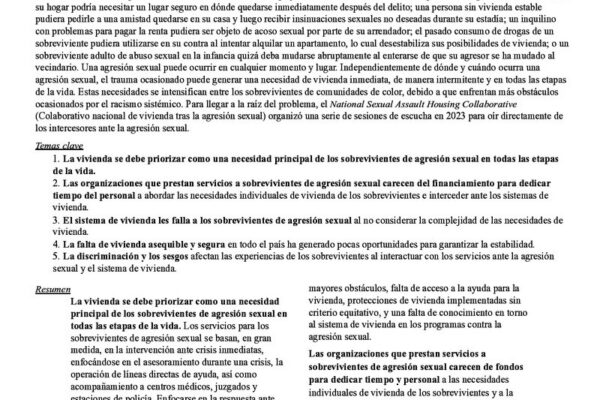
Exploración de la intersección de la agresión sexual y la vivienda: conclusiones clave de las sesiones de escucha
National Alliance to End Sexual Violence
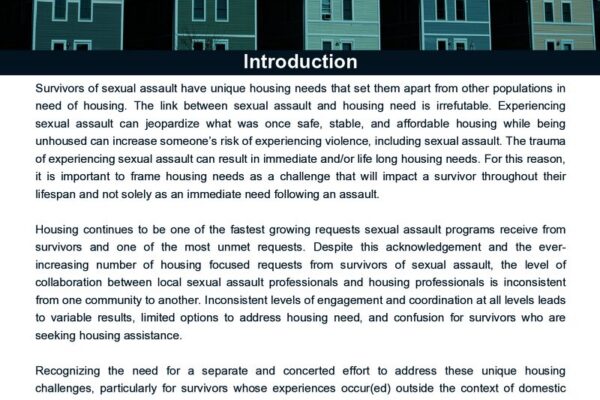
Housing and Sexual Assault Toolkit
Recognizing the need for a separate and concerted effort to address these unique housing challenges, particularly for survivors of sexual assault whose experiences occur(ed) outside the context of domestic violence, the National Sexual Assault Housing Collaborative developed this toolkit for:
– sexual assault service providers to build a foundational knowledge around housing and equip advocates to meet survivors housing needs throughout their lifespan, and
– housing professionals, including transitional housing service providers, to elevate the unique housing challenges experienced by sexual assault survivors and improve housing outcomes for survivors.
It is comprised of downloadable resources designed to encourage organizations to explore current housing service provision through a sexual assault lens. From knowledge building around sexual assault survivors housing challenges and funding that can be used to support this work to tools that promote future housing strategy, this toolkit serves as one component of an organization’s journey to meet sexual assault survivors housing needs. It does not serve as a substitute for cross-training opportunities or connection with local, state, or national experts.

Battered Women’s Justice Project
ESPOC: Project Coordinator Job Description and Template
This resource provides a guide and a template to support the hiring process and job description development for the ESPOC Project Coordinator.

Battered Women’s Justice Project
ESPOC: Training and Technical Assistance Framework for Court Pilot Sites
This document gives a broad overview of the training and technical assistance to be provided to the Electronic Service Protection Order Court (ESPOC) Pilot Project sites.
Battered Women’s Justice Project
ESPOC: Mapping as a Tool for Systems Change
Process mapping is a systematic, step-by-step approach that uses flowcharts and other visual tools to clearly describe how a process works and who is involved at each stage. The goal is to ensure that no steps are overlooked while also identifying areas of uncertainty that may require further discussion or clarification.
A key strength of process mapping is its collaborative nature. It draws on the experiences and expertise of everyone involved in the process, using teamwork to accurately outline each step from start to finish. This shared approach improves understanding, alignment, and accountability across the group.
As part of effective project planning, process mapping helps teams collectively identify strengths, gaps, challenges, and opportunities for improvement. By pinpointing where these factors occur within the process, teams can make informed decisions, streamline workflows, and improve overall performance.
Video link: https://vimeo.com/1133597735/3bdbbbe51c