
Recently Added
Attorney Safety Guide
Attorneys who work on cases involving domestic and dating violence, sexual assault, and stalking (DVSAS)… Read more
Battered Women’s Justice Project
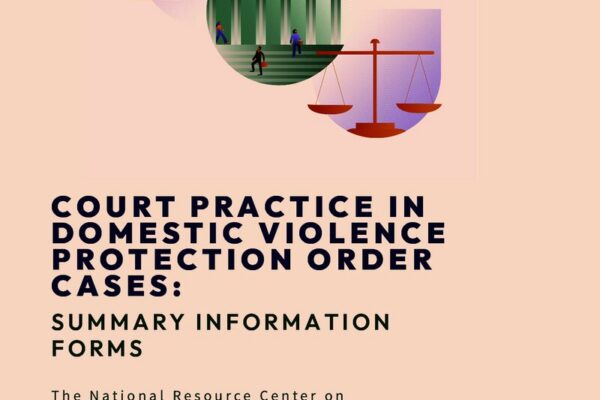
Court Practice in Domestic Violence Protection Order Cases: Creating Court Summary Information Forms
Because protection orders can be the basis by which someone is ineligible to receive a… Read more

Battered Women’s Justice Project
Court Practice in Misdemeanor Crimes of Domestic and Dating Violence Cases: Creating Court Summary Information Forms
Because misdemeanor convictions for crimes of domestic and dating violence can be the basis by… Read more
Battered Women’s Justice Project
U.S. v. Rahimi: Understanding the Implications for Protection Orders and Firearms Prohibitions
In June 2024, the U.S. Supreme Court upheld the federal law that prohibits domestic abusers… Read more

Battered Women’s Justice Project
What High Schools and Colleges Need to Know About Dating Violence and Firearms
In the United States, one in eight high school students reports having been subjected to… Read more
Voluntary Services
The Voluntary Services approach is based on the notion that participation in services should be voluntary and not a condition of housing or receiving other services. This approach emphasizes respectful and welcoming behavior in all aspects of the work. Services are driven by the needs, wants, and individual goals of survivors. This one page handout provides helpful information for Program Providers.
Webinar Series on Routes to Immigration Status for Non-Citizen Crime Survivors
On April 3, 2017, ASISTA presented a webinar on: Intermediate/Advanced U Visas: Overcoming Difficult Inadmissibility Issues, Obtaining U Visa Extensions, and Including Family Members at Adjustment To listen to this webinar recording, please clink here: Recording:https://www.youtube.com/playlist?list=PLTifzqDcaHT35RLSiIQbEdQnAkcRqMUph
What Courts Should Know About Probation Supervision of Domestic Violence Offenders
Domestic violence cases involve serious safety concerns that make monitoring compliance especially difficult. Abusive partners may continue to harass and coerce their intimate partners without the knowledge of the justice system. For courts seeking to ensure compliance and support behavior change among people who abuse their partners, strong communication and collaboration with probation departments is key. This guide discusses what courts should know about specialized probation for domestic violence offenders, providing a series of questions that courts can ask and offering recommendations.
What Courts Should Know: Trends in Intervention Programming for Abusive Partners
Programs that work with perpetrators of intimate partner violence are changing as practitioners across the United States employ new strategies to improve outcomes for both offenders and survivors. Courts and judges have an opportunity to build on this exciting time of change. This document describes the innovative approaches to risk assessment, treatment modality, compliance, and procedural fairness that intervention programs for abusive partners are using to enhance victim safety and offender accountability.
Sexual Violence Justice Institute at the Minnesota Coalition Against Sexual Assault
What Do Sexual Assault Cases Look like in our Community – A SART Coodinator’s Guidebook for Case File Review
What Do Sexual Assault Cases Look Like in Our Community? A SART Coordinator’s Guidebook for Case File Review Over the last several years, the Sexual Violence Justice Institute at the Minnesota Coalition Against Sexual Assault has worked to learn best practices and find better ways to complete case file reviews as an evaluation strategy for Sexual Assault Response Teams (SARTs). Case file review is one way for multi-disciplinary teams to learn about their actual response to victims versus what they believe is happening during the response, and can be an exceptionally valuable strategy to identify ways to improve system response and agency practice to sexual assault. The case file review process is broken down into nine modules. Designed to be easy to use and understand, each module is only a few pages in length and includes two sections: 1) Facilitator’s Guide and 2) Lesson Plan. This toolkit is meant to be adaptable to the needs of SART teams and the community. There are additional tools and resources embedded throughout the toolkit.
Sexual Violence Justice Institute at the Minnesota Coalition Against Sexual Assault
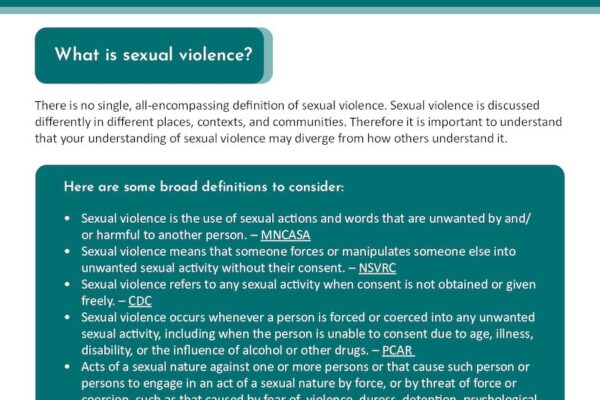
What is Sexual Violence
This resource review definitions of sexual violence and the importance of having a nuanced definition of sexual violence.
Who are male survivors of sexual harassment and assault
Men who survive sexual violence come from many different backgrounds and communities. In this infographic, we share statistics on the race, ethnicity, sexual orientation, gender identity, and disabilities of men who have experienced sexual assault.
Sexual Violence Justice Institute at the Minnesota Coalition Against Sexual Assault
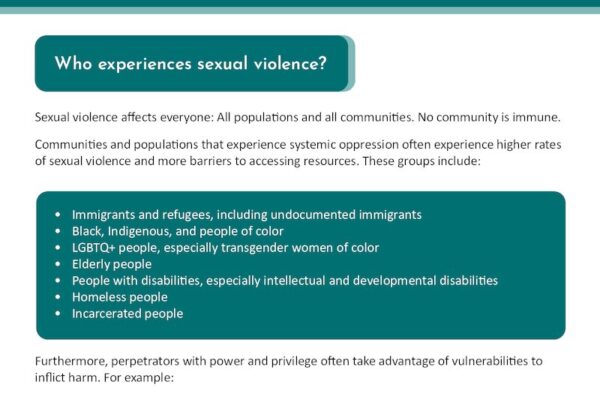
Who is Impacted by Sexual Violence
This resource reviews who is or can be affected by sexual violence.

National Network to End Domestic Violence
Working Remotely: Tips for Setting Up Phones
Whether advocates are being asked to work from home during a public health crisis or they are able to work from home as part of their regular schedule, being able to securely receive and send calls, text messages, and chats is critical. This resource includes answers and tips to commonly asked questions when setting up remote phone access.
National Clearinghouse on Abuse in Later Life (NCALL)
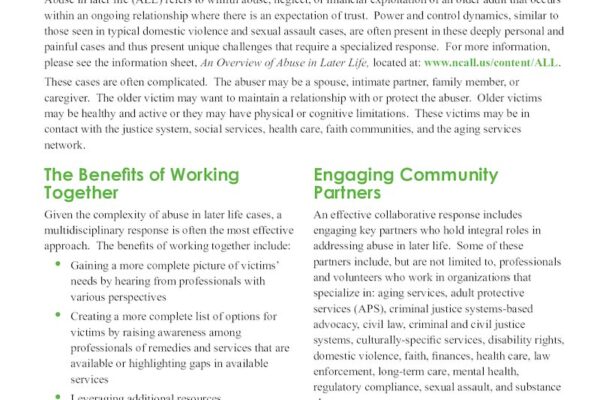
Working Together to Effectively Address Abuse in Later Life
A reminder to reach out to all necessary agencies and organizations when working with abuse in later life cases.