
Recently Added
National Network to End Domestic Violence
Proveedores de Servicios a las Víctimas y Filtraciones de Datos: Consideraciones para el Desarrollo de Políticas Efectivas
Si se infringen los registros electrónicos y la información personalmente identificable se divulga fuera de… Read more
National Network to End Domestic Violence
Data Breaches & Victim Service Providers: Considerations for Developing Effective Policies
Many victim service providers now maintain electronic records that contain detailed personally identifying information (PII)… Read more
Inspire Action for Social Change
Program Guidance: Supporting Program Participants Experiencing Mental Health Distress in Supervised Visitation and Safe Exchange Programs – Including Expressions of Self-Harm or Harm to Others
This guidance helps SV&SE staff recognize and respond to participants’ mental health distress (including self-harm… Read more
Police Executive Research Forum
Tip Sheet: Ensuring Accountability in Officer-Involved Domestic Violence
Creating legitimacy and ensuring public trust begin with holding our own professionals accountable and enforcing… Read more
Police Executive Research Forum
Tip Sheet: Recognizing and Challenging Assumptions and Stereotypes
Every call involving domestic violence or sexual assault requires more than just a procedural response.… Read more
Police Executive Research Forum
5 Tips on Identifying the Predominant Aggressor in Domestic Violence Incidents
Law enforcement officers are often called upon to respond to domestic dispute calls in which… Read more
Stalking Prevention, Awareness, and Resource Center (SPARC)
Supporting Victims of Stalking: Quick Tips for Friends/Loved Ones (Spanish)
A handout (in Spanish) detailing ways one can show support to friends, family, and others who may be experiencing stalking.

Safe Havens Interfaith Partnership Against Domestic Violence (Third Sector New England, Inc.)
Supporting Victims and Survivors of Dating Violence in our Faith Communities
Written for faith leaders (clergy and lay) who want to learn about dating violence, how it might affect their community, and where to find additional resources.
Safe Havens Interfaith Partnership Against Domestic Violence (Third Sector New England, Inc.)
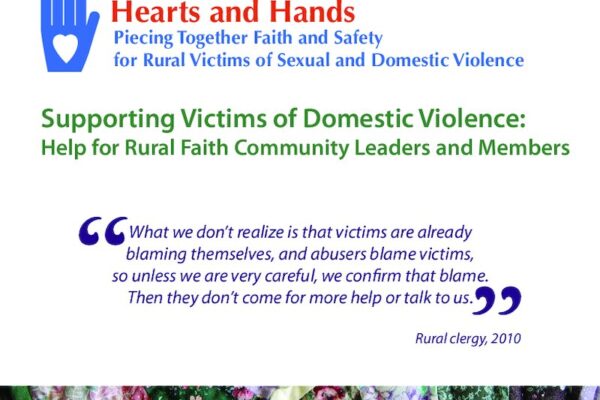
Supporting Victims of Domestic Violence: Help for Rural Faith Community Leaders and Members
Domestic violence is particularly dangerous in rural communities, where victims seeking safety may confront barriers such as geographic isolation, lack of privacy and confidentiality, or scarce resources and services. This guide helps faith communities learn how to be a resource for victims and survivors of domestic violence.
Safe Havens Interfaith Partnership Against Domestic Violence (Third Sector New England, Inc.)
Supporting Victims of Stalking in our Faith Communities
This resource is written for faith leaders and congregations to provide information about stalking, the victims and perpetrators, and where to find additional resources.

Survey Tip Sheet
This tip sheet goes over the reasons why you should create surveys, and when to conduct surveys.
Stalking Prevention, Awareness, and Resource Center (SPARC)
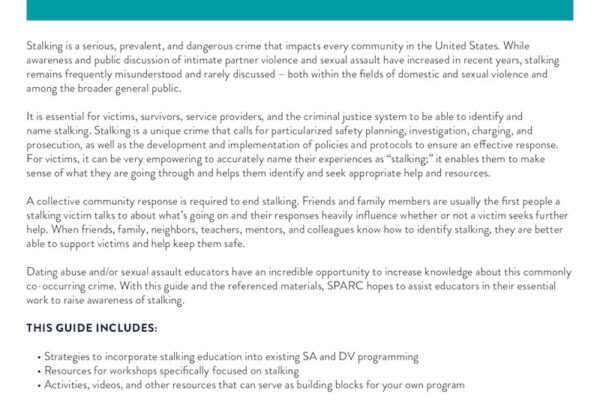
Talking Stalking: A Guide for Prevention/Awareness Educators
This guide includes strategies to incorporate stalking education into existing SA and DV programming; resources for workshops specifically focused on stalking; and activities, videos, and other resources that can serve as building blocks for your own program
National Clearinghouse on Abuse in Later Life (NCALL)
Tech Safety and Older Adults (Black and White)
In 2014, NCALL, with contributions from Disability Rights Wisconsin and the Safety Net Project of the National Network to End Domestic Violence, released a series of handouts aimed at helping older adults identify ways to safeguard themselves from those who misuse technology to control, harass, stalk, and/or threaten them. In 2020, NCALL updated and expanded those resources to create a new toolkit. It is available both in full-color and in printer-friendly black and white.
National Clearinghouse on Abuse in Later Life (NCALL)
Tech Safety and Older Adults (Full Color)
In 2014, NCALL, with contributions from Disability Rights Wisconsin and the Safety Net Project of the National Network to End Domestic Violence, released a series of handouts aimed at helping older adults identify ways to safeguard themselves from those who misuse technology to control, harass, stalk, and/or threaten them. In 2020, NCALL updated and expanded those resources to create a new toolkit. It is available both in full-color and in printer-friendly black and white.

National Network to End Domestic Violence
Tech Talk: Tech Misuse 101: Principles, Dynamics, and Safety Planning.
This 20-30 minute talk will discuss Safety Net’s basic foundational principles that guide our technical assistance and content. We will also discuss the common tactics of power and control and how tech is used to cause harm. Lastly, we will provide safety planning tips and guidance for advocates who are working with survivors.
National Network to End Domestic Violence
Tech Talk: Virtual Discussion Non Consensual Intimate Image Sharing (NCII)
In this 20-minute discussion, we discuss how NCII is used as a tool in patterns of intimate partner violence to cause harm to survivors. We will discuss the impact that this issue has on the life of survivors and how they can seek support online and offline. Tips and techniques will also be provided for advocates to support survivors who are experiencing NCII.