
Recently Added
National Network to End Domestic Violence
Proveedores de Servicios a las Víctimas y Filtraciones de Datos: Consideraciones para el Desarrollo de Políticas Efectivas
Si se infringen los registros electrónicos y la información personalmente identificable se divulga fuera de… Read more
National Network to End Domestic Violence
Data Breaches & Victim Service Providers: Considerations for Developing Effective Policies
Many victim service providers now maintain electronic records that contain detailed personally identifying information (PII)… Read more
Inspire Action for Social Change
Program Guidance: Supporting Program Participants Experiencing Mental Health Distress in Supervised Visitation and Safe Exchange Programs – Including Expressions of Self-Harm or Harm to Others
This guidance helps SV&SE staff recognize and respond to participants’ mental health distress (including self-harm… Read more
Police Executive Research Forum
Tip Sheet: Ensuring Accountability in Officer-Involved Domestic Violence
Creating legitimacy and ensuring public trust begin with holding our own professionals accountable and enforcing… Read more
Police Executive Research Forum
Tip Sheet: Recognizing and Challenging Assumptions and Stereotypes
Every call involving domestic violence or sexual assault requires more than just a procedural response.… Read more
Police Executive Research Forum
5 Tips on Identifying the Predominant Aggressor in Domestic Violence Incidents
Law enforcement officers are often called upon to respond to domestic dispute calls in which… Read more
Inspire Action for Social Change
Resuming On-Site Supervised Visitation Services Safely in a Time of a National Health Crisis
Resuming On-Site Supervised Visitation Services Safely for Families Experiencing Domestic Violence in a Time of a National Health Crisis

Responses To Urban Native Programs Resource Guide
The purpose of this resource is to enhance victim services and justice responses for American Indian and Alaska Native populations residing within urban areas. This guide will focus on addressing unique challenges experienced by Native victims and improving the coordination and service provisions between both non-tribal and tribal organizations.
Roundtable Discussion on Justice for Sexual Violence Survivors from the API Communities
The National Organization of Asians and Pacific Islanders Ending Sexual Violence (NAPIESV) is an alliance established by Asian and Pacific Islander advocates with the purpose of centering and supporting victims of sexual assault from API communities. NAPIESV provides technical assistance and training to local/community-based programs and governmental organizations across the nation and in the U.S. territories, improving their services for victims of sexual violence. This report documents the advancement of one of NAPIESV’s primary goals, namely the creation of spaces to discuss sexual violence in the API communities.
Battered Women’s Justice Project
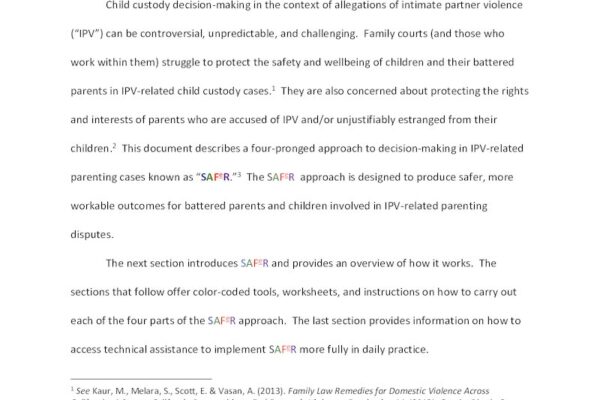
Re-Tooled SAFeR Manual with Detailed Worksheets
This is one of the tools used in the SAFeR approach. SAFeR is an approach to decision making in IPV-related family law matters. It consists of four parts: (1) screening for IPV; (2) assessing the full nature and context of IPV; (3) focusing on the effects of IPV; and (4) responding to IPV in all recommendations, decisions, and interventions. For more information, please see http://www.bwjp.org/our-work/projects/safer.html
Safe Havens Interfaith Partnership Against Domestic Violence (Third Sector New England, Inc.)
Rural Partnership Guide
This guide explores partnership building in rural communities between rural service providers and faith communities. In these regions in particular, it’s critically important for these two groups to come together to support victims and survivors of domestic and sexual violence. This guide is the first step to building those partnerships.
Rural Survivors and Economic Security
Part of the Population Policy Series, this brief examines the barriers that rural survivors face in building economic security, escaping or recovering from abuse, and seeking support and justice. The series offers concrete strategies and solutions that direct service providers, coalitions, STOP administrators and policy makers can implement to better support the safety and economic security of these underserved groups.
Battered Women’s Justice Project
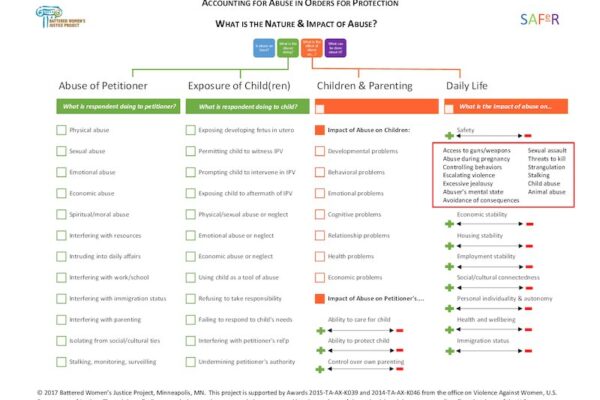
SAFeR Civil Protection Order Guide
This is one of the tools used in the SAFeR approach. SAFeR is an approach to decision making in IPV-related family law matters. It consists of four parts: (1) screening for IPV; (2) assessing the full nature and context of IPV; (3) focusing on the effects of IPV; and (4) responding to IPV in all recommendations, decisions, and interventions. For more information, please see http://www.bwjp.org/our-work/projects/safer.html

Safe for the Holidays
Tips to Support Survivors of Domestic & Sexual Violence during the Holiday Season
Battered Women’s Justice Project
SAFeR Compiled Practice Guides
This is one of the tools used in the SAFeR approach. SAFeR is an approach to decision making in IPV-related family law matters. It consists of four parts: (1) screening for IPV; (2) assessing the full nature and context of IPV; (3) focusing on the effects of IPV; and (4) responding to IPV in all recommendations, decisions, and interventions. For more information, please see http://www.bwjp.org/our-work/projects/safer.html
Battered Women’s Justice Project
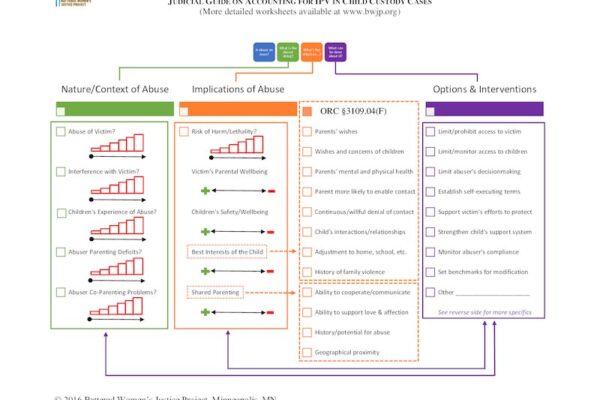
SAFeR Judicial Guide with Specific Detail
This is one of the tools used in the SAFeR approach. SAFeR is an approach to decision making in IPV-related family law matters. It consists of four parts: (1) screening for IPV; (2) assessing the full nature and context of IPV; (3) focusing on the effects of IPV; and (4) responding to IPV in all recommendations, decisions, and interventions. For more information, please see http://www.bwjp.org/our-work/projects/safer.html