
Recently Added
Attorney Safety Guide
Attorneys who work on cases involving domestic and dating violence, sexual assault, and stalking (DVSAS)… Read more
Battered Women’s Justice Project
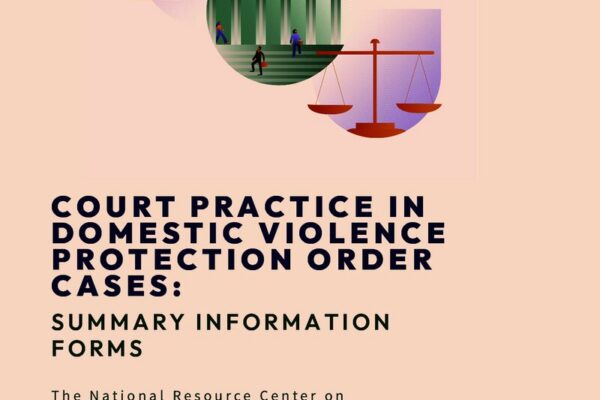
Court Practice in Domestic Violence Protection Order Cases: Creating Court Summary Information Forms
Because protection orders can be the basis by which someone is ineligible to receive a… Read more

Battered Women’s Justice Project
Court Practice in Misdemeanor Crimes of Domestic and Dating Violence Cases: Creating Court Summary Information Forms
Because misdemeanor convictions for crimes of domestic and dating violence can be the basis by… Read more
Battered Women’s Justice Project
U.S. v. Rahimi: Understanding the Implications for Protection Orders and Firearms Prohibitions
In June 2024, the U.S. Supreme Court upheld the federal law that prohibits domestic abusers… Read more
Battered Women’s Justice Project
What High Schools and Colleges Need to Know About Dating Violence and Firearms
In the United States, one in eight high school students reports having been subjected to… Read more

National Council of Juvenile and Family Court Judges
Framework for Developing School Policies to Address Domestic Violence, Dating Violence, Sexual Assault and Stalking
Effective school policies form the foundation of a comprehensive abuse intervention prevention and response framework. At the most basic level, policies guide teachers and administrators in their response to an incident of violence. However, school policies can also shape a school’s climate by creating a space where healthy relationships are encouraged and abusive behaviors are responded to and handled in a way that supports students. This guide will assist schools and school districts in developing comprehensive policies addressing healthy relationships and abuse intervention and response as well as offer ideas and examples for developing procedures that are responsive to the needs of all student survivors. *Former product of Break the Cycle now a resource of NCJFCJ*

National Council of Juvenile and Family Court Judges
Frequently Asked Questions about Electronic Filing in Cases Involving Domestic Violence
This document discusses some of the considerations that should be considered when expanding electronic filing (e-filing) for self-represented victims of domestic violence in abuse cases.

Battered Women’s Justice Project
Full Faith and Credit for Protection Orders: Assisting Survivors with Enforcement Across Jurisdictional Lines
‘Full Faith and Credit for Protection Orders: Assisting Survivors with Enforcement Across Jurisdictional Lines’ is a National Center on Protection Orders and Full Faith & Credit resource guide for advocates.
Tribal Law and Policy Institute
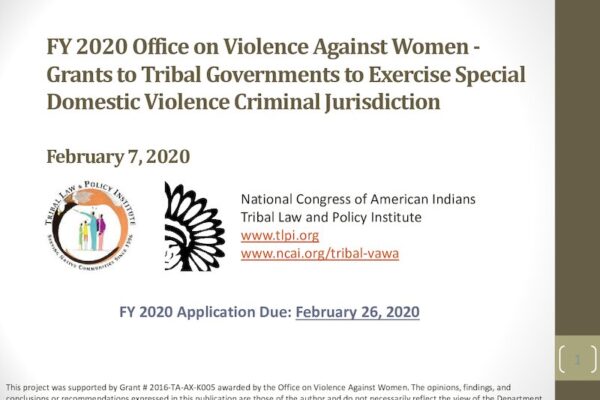
FY20 Office on Violence Against Women Grants to Tribal Governments to Exercise Special Domestic Violence Criminal Jurisdiction
Presentation on FY 2020 OVW Grants to Tribal Governments to Exercise Special Domestic Violence Criminal Jurisdiction (SDVCJ)
Tribal Law and Policy Institute
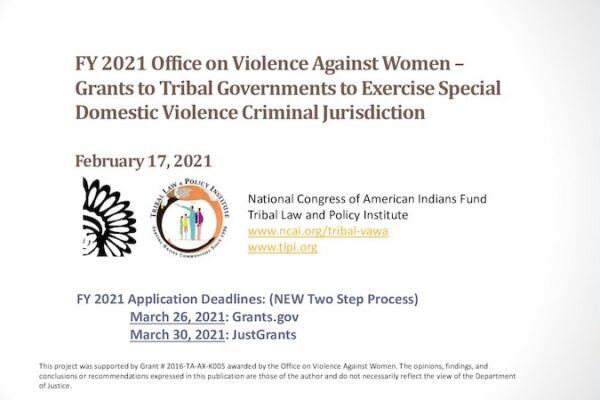
FY21 OVW Grants to Tribal Governments to Exercise SDVCJ
Outline of Webinar Presentation Two separate solicitations: ” FY 2021 OVW Grants to Tribal Governments to Exercise Special Domestic Violence Criminal Jurisdiction (SDVCJ) – Standard ” FY 2021 OVW Grants to Tribal Governments to Exercise SDVCJ: Targeted Support for Exercising Tribes Solicitation – Targeted ” General Grant Writing Tips “
Guide for University Discipline Panels on Sexual Violence
Drawing extensively from NJEP’s publication “Judges Tell: What I Wish I Had Known Before I Presided in an Adult Victim Sexual Assault Case,” the University of Pennsylvania developed a guide titled “Sexual Misconduct Complaints: 17 Tips for Student Discipline Adjudicators, intended for adaptation by individual academic institutions.” It is offered as a template for nonprofit colleges and universities. This resources provides some of the training . . . in handling complaints of sexual harassment and sexual violence” that the U.S. Department of Education Office on Civil Rights Dear Colleague Letter of April 4, 2011 recommended fact-finders and decision-makers in sexual violence cases receive. Another major source for this guide is a 2000 report from the United States Department of Justice: “The Sexual Victimization of College Women,” which provides statistical snapshots of the frequency of campus sexual assault, the relationships between complainants and alleged assailants, and other matters. If your school adapts this resource, please leave the first footnote in the guide intact, as it credits the work of the University of Pennsylvania and the National Judicial Education Program. “
Guide To Safety Planning
Training materials to support youth in rural communities.

Inspire Action for Social Change
Guide to Using Zoom as the Virtual Video or Audio Platform to Conduct Remote Supervised Visitation
Guide to Using Zoom as the Virtual Video or Audio Platform to Conduct Remote Supervised Visitation
Center for Survivor Agency and Justice
Guidebook on Consumer and Economic Civil Legal Advocacy for Survivors
The purpose of this Guidebook is to offer concrete consumer and economic civil legal remedies, as well as nonlegal advocacy strategies, through the lens of survivor centered advocacy – rooted in the experiences of survivors who are living in poverty. This Guidebook was authored and developed in coalition with advocates and attorneys across the country who hold unique expertise at the intersection of consumer law/economic advocacy and domestic violence. Chapters feature a range of consumer and economic civil legal issues, including: – Credit reporting and repair, including discriminatory credit and identity theft – Debt collections and defense, including navigating student loans – Bankruptcy and foreclosure – Federal tax advocacy – Economic relief in civil protection orders – Economic issues in family law – Barriers in civil court – Rights and protections in housing and employment, including advocacy for survivors with criminal records

National Council of Juvenile and Family Court Judges
Guiding Principles for Effectively Addressing Child Custody and Parenting Time in Cases Involving Domestic Violence
The Family Court Enhancement Project (FCEP), an initiative funded by the U.S. Department of Justice, Office on Violence Against Women (OVW), was a multiyear demonstration initiative designed to build the capacity of court systems and partner stakeholders to improve child custody decision-making in cases involving domestic violence. The FCEP enabled the project sites to explore, implement, and assess new and innovative court and non-court procedures and practices designed to improve custody and parenting time decision-making and overcome existing barriers identified during the assessment phase of the project. One important objective of the FCEP, as a demonstration initiative, is to share lessons learned and experiences, and outcomes with other communities so that they can benefit from the focused work at each project site. During the course of its intensive work with the FCEP sites, the project’s TA teams discerned several themes that emerged as each site engaged in efforts to improve its response to domestic violence in child custody cases. Building upon these themes in partnership with multiple stakeholders at each site, we identified five fundamental values that underlie the work and developed a set of Guiding Principles that enable courts and communities to incorporate those values into their systems, processes, and decision-making.