
Recently Added

Attorney Safety Guide
Attorneys who work on cases involving domestic and dating violence, sexual assault, and stalking (DVSAS)… Read more
Battered Women’s Justice Project
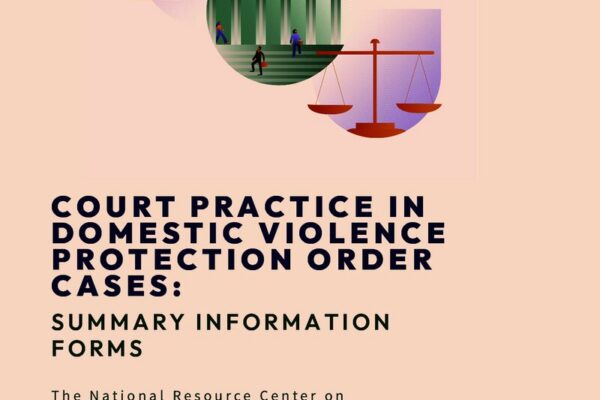
Court Practice in Domestic Violence Protection Order Cases: Creating Court Summary Information Forms
Because protection orders can be the basis by which someone is ineligible to receive a… Read more

Battered Women’s Justice Project
Court Practice in Misdemeanor Crimes of Domestic and Dating Violence Cases: Creating Court Summary Information Forms
Because misdemeanor convictions for crimes of domestic and dating violence can be the basis by… Read more
Battered Women’s Justice Project
U.S. v. Rahimi: Understanding the Implications for Protection Orders and Firearms Prohibitions
In June 2024, the U.S. Supreme Court upheld the federal law that prohibits domestic abusers… Read more
Battered Women’s Justice Project
What High Schools and Colleges Need to Know About Dating Violence and Firearms
In the United States, one in eight high school students reports having been subjected to… Read more

Eligibility Under the Affordable Care Act for Survivors of Domestic Violence, Trafficking, and Other Serious Crimes
This factsheet provides the definition of “lawfully present” under the Affordable Care Act of 2010 to assist attorneys and advocates working with survivors of domestic violence, sexual assault, human trafficking, and neglect to access healthcare plans through the state/federal exchanges.

National Network to End Domestic Violence
Eliminar contenido delicado del Internet
Este recurso explica los pasos que las sobrevivientes o los proveedores de servicios para v?ctimas pueden tomar para eliminar la identificaci?n personal y/o el contenido ?ntimo de las sobrevivientes tanto de los sitios web anfitriones como de los resultados de los motores de b?squeda en el curso de la planificaci?n de la privacidad. Contiene contenido completamente nuevo.

Safe Havens Interfaith Partnership Against Domestic Violence (Third Sector New England, Inc.)
Engaging Latinas Faith Leaders and Communities to Address Domestic Violence
This resource for advocates and service providers offers guidance on how to partner with Latin@s faith communities in order to better serve those in the Latin@s community who experience abuse.

Enhancing Collaboration Between Domestic Violence Courts and Supervised Visitation Services
An addendum to the Center’s Creating a Domestic Violence Court planning toolkit, this document focuses on enhancing the collaboration between courts handling domestic violence cases and supervised visitation and exchange programs. Offering a comprehensive step-by-step process, the addendum advises court staff and stakeholders on creating an effective relationship with supervised visitation centers or improving an existing one.
Estrategias creativas para vincularse y trabajar eficazmente con inmigrantes sobrevivientes de violencia sexual en el centro de trabajo
Webinar presented by ASISTA and Casa de Esperanza on Creative Strategies for Outreaching And Working Effectively with Immigrant Survivors of Sexual Violence in the Workplace.
End Violence Against Women International
EVAWI Training Bulletin Series: Advocates and Law Enforcement: Oil and Water
Adapted from an article originally appearing in Sexual Assault Report, Volume 11, Number 6, 2008, published by Civic Research Institiute. All rights reserved.
End Violence Against Women International
EVAWI Training Bulletin Series: Clearance Methods
This training bulletin series was developed to explain the various methods that law enforcement agencies use for clearing crime reports. In the first installment, we outline the definition and criteria for clearance by arrest. In subsequent bulletins, we explore the other two primary methods: exceptional clearance and unfounding. Finally, we discuss some of the problems and challenges with the way clearance methods are used by various law enforcement agencies across the country.
End Violence Against Women International
EVAWI Training Bulletin Series: Crime Victims’ Rights: Protecting Crime Victims’ Rights
As we so often highlight in our training materials, there are many barriers that prevent the vast majority of sexual assault, domestic violence, and stalking victims from reporting the crime and participating in the process of a criminal prosecution. Not only does this deny victims their right to pursue justice, but it creates a situation where most offenders are given a “free pass” to continue re-perpetrating in our communities. Any steps we can take to reduce these barriers can therefore help victims to engage in the process – and remain engaged – so we can hold more offenders accountable. One strategy for achieving this goal is ensuring that crime victims’ rights are protected. The goal for this training bulletin series is to help community professionals answer the “bottom line,” which is: Are crime victims’ rights real in your community? Are there protocols in place that translate victims’ rights from theory to practice? Are there procedures to ensure that victims are informed of their rights? Are there policies and protocols designating how a victim’s rights will be protected? Is there a process to follow when victims believe their rights have been violated? We hope this training bulletin provides you with the inspiration for collective action, as well as the information and resources needed to help your community answer “yes” to all of these questions.

End Violence Against Women International
EVAWI Training Bulletin Series: Gender Bias in Sexual Assault Response and Investigation
We introduce the concept of implicit bias and briefly review the decades of neurobiological and social scientific research that document its existence and impact. We begin by reviewing the concept of gender, and then defining gender bias, both implicit and explicit. In subsequent bulletins, we will explore strategies that can be used to identify the presence of implicit gender bias and mitigate its influence. We will also address key questions about how implicit gender bias can disadvantage (or advantage) either the victim and/or suspect.

End Violence Against Women International
EVAWI Training Bulletin Series: Investigating Sexual Assault Against People with Disabilities
This training bulletin series is developed from the law enforcement perspective, to improve the investigation and prosecution of sexual assaults perpetrated against people with disabilities. This information is designed to be helpful for any professional whose work intersects with the criminal justice system, to ensure that people with disabilities who are victimized have equal access to information, programs, and services – and that they are treated with fairness, compassion, and respect. Everyone involved in the criminal justice and community response system plays a critical role in providing that access and fair treatment.