
Recently Added
Safe Havens Interfaith Partnership Against Domestic Violence (Third Sector New England, Inc.)
What You Can Do to Support Victims of Sexual and Domestic Violence In Your Congregation
These quick tips can help rural faith communities take the first step towards supporting survivors.
Domestic Violence, Developing Brains, and the Lifespan: New Knowledge from Neuroscience
This article, written by Lynn Hecht Schafran and published in the Summer 2014 issue of The Judges Journal, discusses current science on the impact that witnessing domestic violence has on children’s developing brains.
We are at a watershed knowledge-development point with respect to understanding the impact of domestic violence on children. This has been a subject of judicial concern and commentary for decades. Now, with the advent of magnetic resonance imaging, neuroscientists have produced scores of studies documenting on a neuronal level the profoundly negative impact of exposure to domestic violence on children, and how children can recover when exposure to the violence is eliminated and they are secure in the care of their non-abusing, primary caregiver parent.
Battered Women’s Justice Project
Accounting for Risk and Danger Practice Checklists: Coordinating Risk Assessment in Domestic Violence Cases
Identifying and documenting risk factors for serious or lethal intimate partner violence (IPV) should be incorporated into each step of the criminal justice intervention. A community’s coordinating council or task force can spearhead an examination of current practices to uncover gaps that exist in identifying, documenting and transmitting risk information throughout the criminal justice intervention. To assist such an assessment, BWJP has developed Accounting for Risk and Danger Practice Checklists for each practitioner in the intervention process. The checklists can help a jurisdiction ensure that its criminal justice response identifies and addresses potential risks to victims, based on sound research on risk factors associated with IPV.
Battered Women’s Justice Project
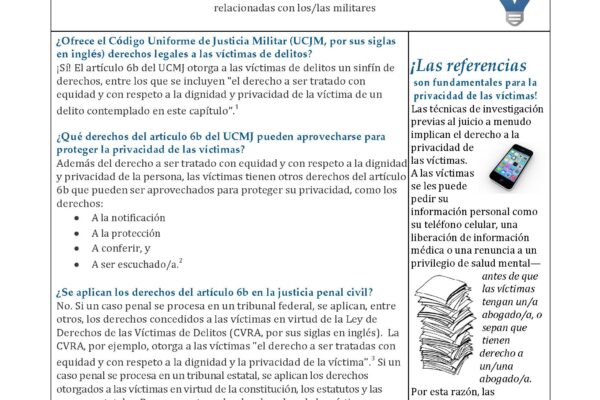
Military-Related Victim Resource Card
This brief tool answers common questions asked by military-related victims and lists online and telephonic resources specific to military personnel, veterans, and their family members.
Battered Women’s Justice Project
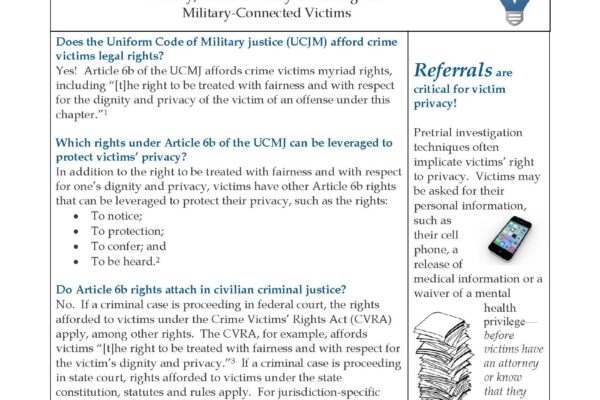
Military-Related Victim Information Handout
This resource provides answers to common questions asked by military-related victims, provides detailed information to military-related victims on combat-related and co-occurring conditions, and lists online and telephonic resources specific to military personnel, veterans, and their family members.
Disability Organizations: Measuring Capacity to Serve Domestic Violence and Sexual Assault Survivors with Disabilities
This manual is designed to improve services for people with disabilities who have experienced domestic and sexual violence. It is our hope that disability organizations that have a strategic objective to serve survivors will adopt the indicators presented in this guide. Disability organizations that measure their capacity to address domestic and sexual violence serves will know with greater certainty the impact of their efforts on the people they serve, and, ultimately, whether they are meeting the global mission of the disability field to promote access, inclusion and self-determination for people with disabilities.
To access the scoring tool for this manual please visit: http://www.endabusepwd.org/publications/indicators-scoring-tools/
Domestic Violence/Rape Crisis Dual Agencies: Measuring Capacity to Serve Domestic Violence and Sexual Assault Survivors with Disabilities
This manual is designed to improve services for people with
disabilities who have experienced domestic violence and/or sexual violence. It is our hope that dual rape crisis/domestic violence (residential and nonresidential) programs that have a strategic objective to serve people with disabilities will adopt the indicators presented in this guide. Dual programs that measure their capacity to serve these survivors will know with greater certainty the impact of their efforts on the people they serve, and ultimately, whether they are meeting the global mission of the domestic violence and sexual assault fields to serve all survivors.
To access the scoring tool for this manual please visit: http://www.endabusepwd.org/publications/indicators-scoring-tools/
Residential Domestic Violence Programs: Measuring Capacity to Serve Domestic Violence and Sexual Assault Survivors with Disabilities
This manual is designed to improve services for people with
disabilities who have experienced domestic violence. It is our hope that residential domestic violence programs that have a strategic objective to serve people with disabilities will adopt the indicators presented in this guide. Residential domestic violence programs that measure their capacity to serve these survivors will know with greater certainty the impact of their efforts on the people they serve, and ultimately, whether they are meeting the global mission of the domestic violence field to serve all survivors.
To access the scoring tool for this manual please visit: http://www.endabusepwd.org/publications/indicators-scoring-tools/
Rape Crisis Centers: Measuring Capacity to Serve Domestic Violence and Sexual Assault Survivors with Disabilities
This manual is designed to improve services for people with disabilities who have experienced sexual violence. It is our hope that rape crisis centers that have a strategic objective to serve people with disabilities will adopt the indicators presented in this guide. Rape crisis centers that measure their capacity to serve these survivors will know with greater certainty the impact of their efforts on the people they serve, and, ultimately, whether they are meeting the global mission of the sexual violence field to serve all survivors.
To access the scoring tool for this manual please visit: http://www.endabusepwd.org/publications/indicators-scoring-tools/
National Clearinghouse on Abuse in Later Life (NCALL)
Reclaiming What is Sacred: Addressing Harm to Indigenous Elders and Developing a Tribal Response to Abuse in Later Life
In early 2015, NCALL conducted a listening session on abuse in later life in tribal communities with representatives from tribal governments, service providers, and individuals working closely with tribes, tribal domestic violence coalitions, and federal responders. Based on the input gathered at the listening session, NCALL, in collaboration with Victoria Ybanez of Red Wind Consulting and Lauren Litton of ISP Consulting, worked together to write the paper, Reclaiming What is Sacred: Addressing Harm to Indigenous Elders and Developing a Tribal Response to Abuse in Later Life. This paper, a resource for tribes and villages on how to create meaningful responses to abuse in later life, identifies specific guiding philosophies, cultural considerations, and potential action steps tribes and villages might wish to do when addressing abuse in later life in their communities. The back of the paper also includes a number of tools to enhance conversation and planning such as: sample stories; tips for holding a listening session; scenarios for community and system consideration; scenarios for thinking about elder abuse and elder protection; areas of inquiry; a questionnaire for collecting input; and the Abuse in Later Life Power and Control Wheel.