
Recently Added
Stalking Prevention, Awareness, and Resource Center (SPARC)
Responding to Military-Connected Survivors of Stalking
Stalking Prevention, Awareness, and Resource Center (SPARC)
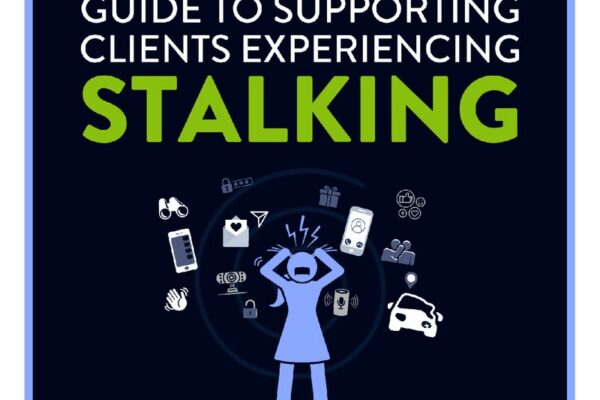
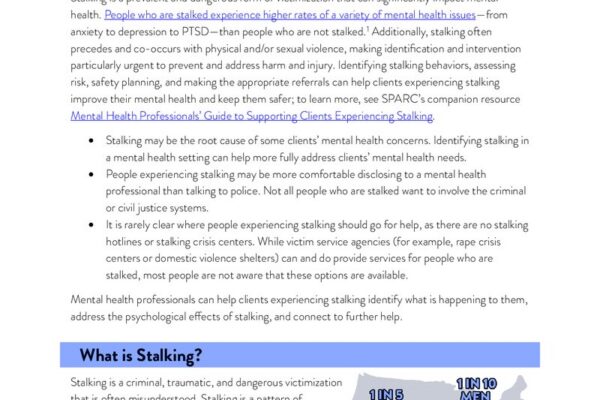
Mental Health Professionals’ Guide to Supporting Clients Experiencing Stalking
Stalking Prevention, Awareness, and Resource Center (SPARC)
Listening for Stalking in Mental Health Settings
Stalking Prevention, Awareness, and Resource Center (SPARC)
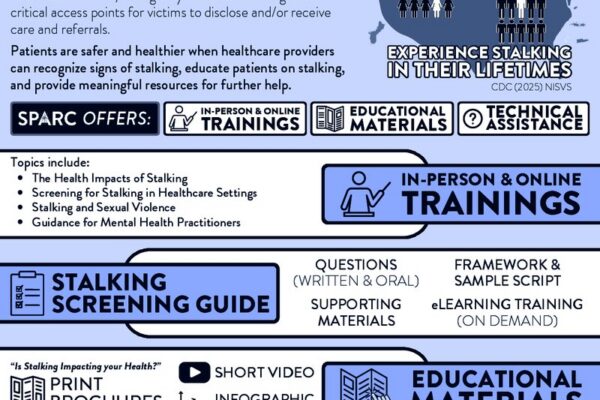
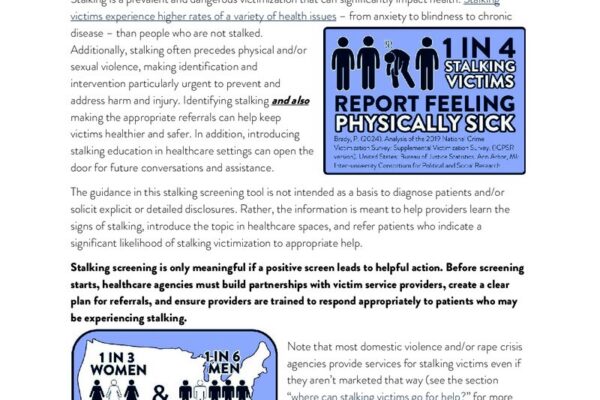
Guide to Screening for Stalking in Healthcare Settings
Stalking Prevention, Awareness, and Resource Center (SPARC)
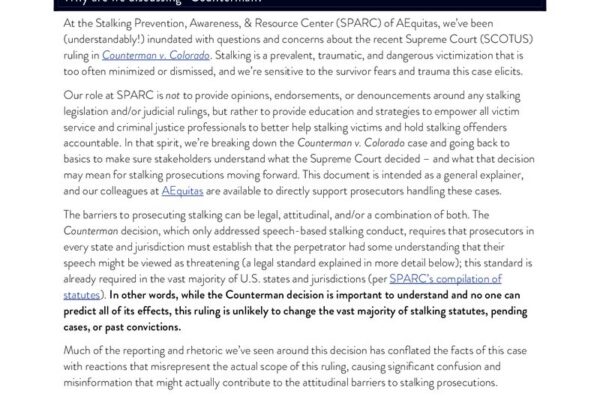
Understanding the Counterman v. Colorado Supreme Court Decision
Inspire Action for Social Change
Guide for Developing Internal and External Relational Policies & Procedures for Supervised Visitation & Safe Exchange Programs
This publication provides guidance to OVW-funded supervised visitation and safe exchange programs to develop internal and external policies & procedures for supervised visitation & safe exchange programs.
Battered Women’s Justice Project
Understanding The Difference Between a Domestic Violence Protection Order (DVPO) And an Extreme Risk Protection Order (ERPO)
“A domestic violence protection order (DVPO) is issued by a court to protect a survivor of family or intimate partner abuse/violence and requires the person subject to the order to do, or not do, certain actions. DVPOs can protect the survivor in many ways, including: ordering the respondent from coming near the survivor or their home or workplace, from communicating with the survivor, providing for custody or visitation, provisions related to housing, express prohibitions against further harassment, threats, stalking or other abusive behaviors against the survivor and their children. DVPOs can also prohibit the respondent from accessing firearms or ammunition during the time the DVPO is in effect. All U.S. states and territories have laws providing for DVPOs.
As of late 2024, 21 U.S. states and Washington, D.C. have laws providing for extreme risk protection orders (ERPO), a court order that requires the person subject to the order to turn in firearms and ammunition in their possession and can prohibit the respondent from purchasing firearms and ammunition while the order is in effect.
It is important for survivors to have access to information about the differences between these legal tools.”

Battered Women’s Justice Project
The New Misdemeanor Dating Violence Federal Firearms Prohibitor: An FAQ for Victim Advocates
This resource explains what changes the Bipartisan Safer Communities Act made to narrow the so-called “boyfriend loophole,” how “dating relationships” are defined by this law, and how victim advocates can support survivors whose current or former dating partners may have access to, or be prohibited from accessing, firearms.

Battered Women’s Justice Project
State Statutes on Firearm Relinquishment in Cases Involving Intimate Partner Violence
“This chart includes information about state laws that speak to expressly authorized or
mandated firearm relinquishment orders in civil protection order and criminal cases involving intimate partner violence. The information is current as of September 2024, may not be all-inclusive, and is intended only for educational and research purposes. State statutes are constantly changing. Additionally, the absence of statutory provisions related to relinquishment does not mean state and local authorities lack the authority to implement relinquishment processes.”

Battered Women’s Justice Project
Research at the Intersection of Intimate Partner Violence and Firearms
Prevalence rates of both intimate partner violence and gun violence remain pervasive. Research demonstrates a lethal association when intimate partner violence and firearms are combined.
Battered Women’s Justice Project
Promising Practices: Federal-State-Local Coordinated Justice System Responses to Domestic Violence and Firearms
“Over several months in 2024, the National Resource Center on Domestic Violence and Firearms (NRCDVF) conducted site visits in three communities, each of which has developed a multi-jurisdictional collaboration with the specific goal of addressing firearm-facilitated domestic violence and domestic violence-derived community violence through better implementation and enforcement of the federal laws that prohibit certain abusers from accessing firearms.
Those communities—DeKalb County, GA; Oklahoma City, OK; and Birmingham, AL—each developed a collaborative initiative that reflects their community and its needs. Each of these three programs are discussed in this resource, including who participates in the initiative, how resources are allocated, the shape the program takes, and the benefits to each community.
The aim of this resource is to provide these models as ones which may be adopted, or adapted, for your own community. The partners within each of these community models were gracious and generous in offering honest reflection on the process of developing these initiatives. The last section of this resource is a set of tips taken directly from the experience of these communities.”

Battered Women’s Justice Project
Firearms Relinquishment in Cases Involving Intimate Partner Violence: How to Structure Effective Protocols For You Community
This resource details the importance of having a firearm relinquishment protocol and provides steps for developing a coordinated community response and developing an effective protocol that can be institutionalized and has a separate appendix of relevant state statutes.

Battered Women’s Justice Project
A Brief History and Framework of Federal Firearms Laws Addressing Intimate Partner Violence
Federal law provides a framework to keep guns out of the hands of those who perpetrate domestic violence. Those laws can be complex to understand. This resource provides a basic explanation of the current federal firearms laws that address intimate partner violence, how those laws triggered and how they interact.
Trauma-Informed Caseload Assessment Tool
In order to safely and ethically represent survivors who have experienced trauma, attorneys need to have manageable caseloads. Unmanageable caseloads can lead to attorney burnout, which in turn causes high organizational turnover rates and decreased quality of services. Overlarge caseloads can even lead to legal malpractice, which can harm clients, expose an organization to lawsuits and reputational damage, and ultimately impact the organization’s ability to provide legal services.
While many organizations strive to keep their caseloads sustainable, few resources exist to help organizations evaluate whether a caseload is sustainable. We created this tool to help legal services organizations determine what constitutes a reasonable and manageable caseload—a caseload that allows time for effective, client-centered representation and promotes staff wellness and resilience.
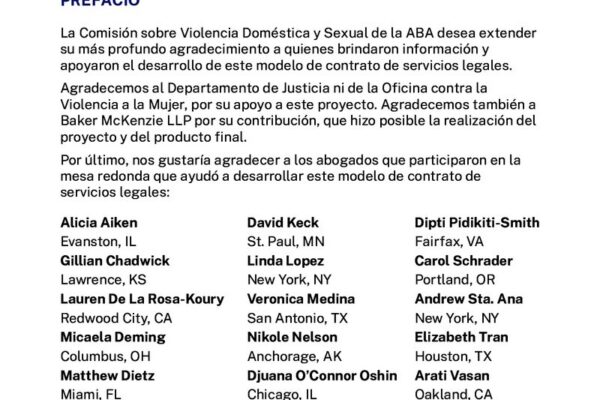
Modelo de Contrato de Servicios Legales (Model Legal Services Agreement – Spanish)
Este modelo de contrato de servicios legales está destinado a servir como guía de mejores prácticas para los abogados que representan a víctimas de
violencia de género.