
Recently Added
Conducting Legal Intakes with LGBTQ+ Survivors
Attorneys for survivors of domestic violence, dating violence, sexual assault, and stalking can develop trust… Read more
Stalking Prevention, Awareness, and Resource Center (SPARC)
Responding to Military-Connected Survivors of Stalking
Stalking Prevention, Awareness, and Resource Center (SPARC)
Mental Health Professionals’ Guide to Supporting Clients Experiencing Stalking
Stalking Prevention, Awareness, and Resource Center (SPARC)
Listening for Stalking in Mental Health Settings
Stalking Prevention, Awareness, and Resource Center (SPARC)
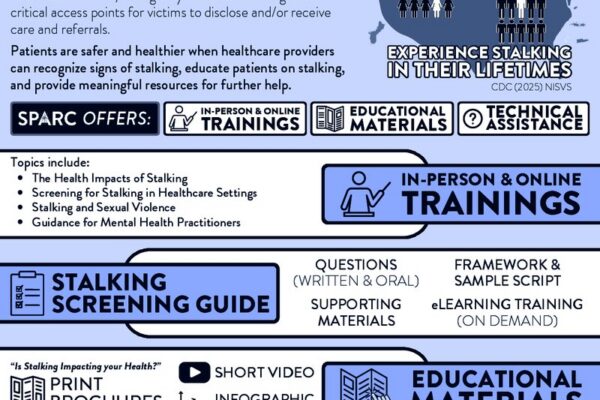
Guide to Screening for Stalking in Healthcare Settings

Red Wind Consulting, Inc.
Sexual Assault Awareness Month Ideas
Campus Sexual Assault Awareness Month
Ideas Factsheet
Red Wind Consulting, Inc.
Implementing A Culturally Holistic Sexual Assault Response on Your Campus
Implementing A Culturally Holistic Sexual Assault Response on Your Campus- Fact Sheet
Red Wind Consulting, Inc.
Why Your Campus Needs A Culturally Holistic Sexual Assault Response
Why Your Campus Needs A Culturally Holistic Sexual Assault Response- Fact Sheet
Red Wind Consulting, Inc.
Components of a Holistic Sexual Assault
Components of a Holistic Sexual Assault- Fact Sheet
Red Wind Consulting, Inc.
Unique Legal Issues for Indigenous Survivors in Urban Areas
Unique Legal Issues for Indigenous Survivors in Urban Areas
Red Wind Consulting, Inc.
A Resource for Non-Native Providers
A Resource for Non-Native Providers: Working to address violence against American Indians and Alaska Natives
Red Wind Consulting, Inc.
AI/AN Urban Population Fact Sheet
AI/AN Urban Population Fact Sheet
ASISTA Practice Pointer: Correctly Identifying the Expiration Date of U Nonimmigrant Status (Updated February 8, 2024)
Many practitioners report uncertainty about the date their client’s U status expires because the client has multiple documents defining the validity of their status. For instance, a U derivative may have: (1) the I-797 approval notice for the principal’s I-918, (2) the I-797 approval notice for their own I-918A, (3) a U-3 (or other derivative U category) visa in their passport, (4) an I-94 from CBP, and (5) a passport entry stamp.
Sometimes the expiration date on one of these documents is different from others. This resource provides strategies to address expiration date discrepancies, obtain a copy of the I-94, which is generally controlling, and develop an appropriate plan for filing that preserves your client’s rights.
ASISTA’s OVW-Funded Products, 2021-2023 Grant Period
This document contains all practice advisories, practice pointers, alerts, and any other documents produced during our 2021-2023 grant period.
National Network to End Domestic Violence
Conceptos basicos de cifrado para programas atencion a las personas sobrevivientes de la violencia de genero
Esta guía presenta a los proveedores de servicios para víctimas los conceptos básicos de cifrado y su aplicabilidad para trabajar con sobrevivientes y para su seguridad.