
Recently Added
Conducting Legal Intakes with LGBTQ+ Survivors
Attorneys for survivors of domestic violence, dating violence, sexual assault, and stalking can develop trust… Read more
Stalking Prevention, Awareness, and Resource Center (SPARC)
Responding to Military-Connected Survivors of Stalking
Stalking Prevention, Awareness, and Resource Center (SPARC)
Mental Health Professionals’ Guide to Supporting Clients Experiencing Stalking
Stalking Prevention, Awareness, and Resource Center (SPARC)
Listening for Stalking in Mental Health Settings
Stalking Prevention, Awareness, and Resource Center (SPARC)
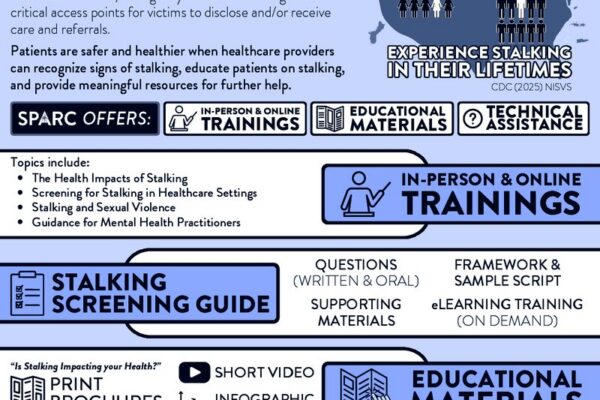
Guide to Screening for Stalking in Healthcare Settings

Sexual Violence Justice Institute at the Minnesota Coalition Against Sexual Assault
Navigating Repressive Legislation: Considerations for Sexual Assault Response Teams
This resource is aimed to assist Sexual Assault
Response Teams (SARTs) in navigating current
and upcoming repressive legislation to ensure
continued support and services for victims/
survivors of sexual violence.
Practice Advisory: Opposing Defendants Requests for U and T Filings in Criminal Proceedings (October 2024)
Immigrant survivors of gender-based violence who apply for U and T Nonimmigrant Status are often required by law to have some interaction with the criminal-legal system. This Practice Advisory, jointly produced by ASISTA and the National Crime Victim Law Institute, identifies when U and T filings may arise in a criminal proceeding and, through the framework of crime victims’ rights, offers promising practices for defending against subpoenas requesting immigrant survivors’ U and T filings.
Part 1: An Introduction to Forced Marriage in the United States
This webinar will provide participants with foundational knowledge of forced marriage as a form of gender-based violence and the abusive tactics often utilized to forced an individual at risk to comply with the marriage demands. We will discuss commonly used terminology with a focus on the various aspects of consent that must be present in any marriage. We will walk through the tools of power and control often used by those perpetrating abuse, including the abuse that may precede a forced marriage, and the forms of violence that can result either by the refusal to marry or within the marriage.
The webinar aims to increase the expertise of service providers with a focus on identifying cases of forced marriage within existing caseloads. There are two QR codes located towards the bottom right-hand side of the first slide that will link to the webinar’s recording. Recordings are available to Spanish and English.
Forced Marriage Initiative Training and Technical Assistance Flyer
The Forced Marriage Initiative Flyer to learn more about how forced marriage intersects with other forms of abuse and how the program can assist with various information related to forced marriage in the United States.
Updated Resource: ASISTA Flyer: Services to OVW Grantees and Sub-grantees (Updated Aug. 2024)
ASISTA Updated Flyer with direct links and information on ASISTA services for OVW LAV grantees/sub-grantees, ELSI grantees, and STOP sub-grantees.
NEWLY DESIGNED: Top Ten Things Domestic Violence and Sexual Assault Advocates Should Know About Immigrant Survivors
ASISTA’s Top Ten List for domestic violence & sexual assault advocates aims to inform advocates about key concepts and barriers impacting immigrant survivors of gender-based violence, while providing resources to help overcome them. (Original, Dec. 8, 2023- Newly Designed: Sept. 2024)
National Council of Juvenile and Family Court Judges
Collaborations to Improve Civil Protection Order Systems
Collaboration is a fundamental element of creating and sustaining lasting change in the civil protection order (CPO) system. According to the NCJFCJ’s Civil Protection Orders: A Guide for Improving Practice (CPO Guide), collaboration helps to provide victims a response that is “unified, cohesive, reliable, and interactive.” By highlighting four communities and their collaborative efforts, this companion publication to the CPO Guide looks at how courts and judicial officers can use their leadership to bring stakeholders and the larger community to the table to better improve their CPO systems.
ASISTA Practice Advisory: Addressing Late-Breaking Inadmissibility Grounds for U Visa Beneficiaries (Aug. 8, 2024)
When a U applicant or recipient fails to waive an applicable inadmissibility ground at any stage, for any reason, it puts their current and future statuses at risk. Yet there do exist strategies to address these “late-breaking” inadmissibility grounds, depending on when they come into being and when you learn of them. This practice advisory describes the current best practices for protecting survivors in these situations, whether before or after I-918/I-192 approval, before or after adjustment of status, or even during the naturalization process.
Practice Alert: Parole in Place and Streamlined Employment-Based Visas: What We Know and What We Want to See for Immigrant Survivors (July 2024)
In June 2024, the Biden Administration announced new programs to promote family reunification and access to employment-based visas for noncitizen graduates of U.S. institutions of higher education. This Practice Alert will outline the requirements for the new Parole in Place (“PIP”) program for spouses and stepchildren of U.S. Citizens, address how immigrant survivors and their children may benefit, detail our unanswered questions and hopes for the PIP program, address the employment-based visa changes, and identify existing parole programs that may benefit immigrant survivors.
Practice Advisory: Establishing Employment Authorization for T and U Nonimmigrants Without an EAD Card (Updated in June 2024)
This Practice Advisory summarizes the differing work authorization rules for T and U principals and derivatives, the instructions in USCIS’s Handbook for Employers regarding T and U nonimmigrants’ methods of proving their work authorization, and the privacy concerns arising from the use of visa status documentation, instead of employment authorization document cards (EADs), to establish work authorization. Practitioners can use this information to advocate for their clients who are authorized to work incident to their status, but are not in possession of a valid EAD.