
Recently Added
National Network to End Domestic Violence
Proveedores de Servicios a las Víctimas y Filtraciones de Datos: Consideraciones para el Desarrollo de Políticas Efectivas
Si se infringen los registros electrónicos y la información personalmente identificable se divulga fuera de… Read more
National Network to End Domestic Violence
Data Breaches & Victim Service Providers: Considerations for Developing Effective Policies
Many victim service providers now maintain electronic records that contain detailed personally identifying information (PII)… Read more
Inspire Action for Social Change
Program Guidance: Supporting Program Participants Experiencing Mental Health Distress in Supervised Visitation and Safe Exchange Programs – Including Expressions of Self-Harm or Harm to Others
This guidance helps SV&SE staff recognize and respond to participants’ mental health distress (including self-harm… Read more
Police Executive Research Forum
Tip Sheet: Ensuring Accountability in Officer-Involved Domestic Violence
Creating legitimacy and ensuring public trust begin with holding our own professionals accountable and enforcing… Read more
Police Executive Research Forum
Tip Sheet: Recognizing and Challenging Assumptions and Stereotypes
Every call involving domestic violence or sexual assault requires more than just a procedural response.… Read more
Police Executive Research Forum
5 Tips on Identifying the Predominant Aggressor in Domestic Violence Incidents
Law enforcement officers are often called upon to respond to domestic dispute calls in which… Read more

Monsoon United – Asian Women of Iowa
Program profile includes best practices to support rural grantees.

Sexual Violence Justice Institute at the Minnesota Coalition Against Sexual Assault
Must-Haves for a Meaningful Response to Sexual Violence
This resource reviews the “must-haves” concepts needed for a meaningful response to sexual violence covered in the Sexual Violence Justice Institute’s STOP Administrators’ Academy.
National Network to End Domestic Violence
My Sudo App Review
A review from the Safety Net Team at NNEDV of the My Sudo privacy app, designed to disconnect online accounts and activity with personal information in order to increase privacy and security.
NAPIESV Community Listening Sessions Report
Listening Sessions Report “No One Can Tell Our Stories But Us: A Dialogue on Sexual Violence in Asian and Pacific Islander Communities

NAPIESV: Roundtable Report on Justice for SA Survivors from the API Communities
This report documents the advancement of one of NAPIESV’s primary goals, namely the creation of spaces to discuss sexual violence in the API communities. Through the years of research, curriculum development and implementation, NAPIESV has learned that one of the central questions to doing work around issues of sexual violence for API survivors is around the question of justice. In particular, the organization and its community partners have consistently explored the question, “What does justice look like for API sexual assault survivors?” In 2017, NAPIESV hosted a roundtable discussion with community leaders and experts who work on issues of sexual violence to explore and define “justice” for API survivors. The roundtable participants who were from across the API diaspora were joined by Black Americans, Black Canadians, Black Caribbeans, and Native American community leaders. The discussion focused on contextualizing the history of sexual violence in the United States as well as traditional concepts of justice.

National Protocol Fact Sheet
A summary sheet of the revisions/changes to the New National SAFE Protocol 2nd Ed. Adult/Adolescent

Native Children and Youth Exposed to Violence Fact Sheet
Native children and youth who are exposed to violence face obstacles that effect their health and wellbeing. Alarmingly Native children and youth experience posttraumatic stress disorder three times the rate of the general U.S. population

Navigating Transitions in Judicial Leadership: Guidance for Domestic Violence Courts
Having a strong judicial leader can make or break a specialized domestic violence court. A judge can marshal resources and rally community and stakeholder partners to achieve shared goals. So what happens to specialized domestic violence courts when that integral judge transitions to a new position or retires? Use this fact sheet to ensure your court has a plan in place for a smooth and successful transition.
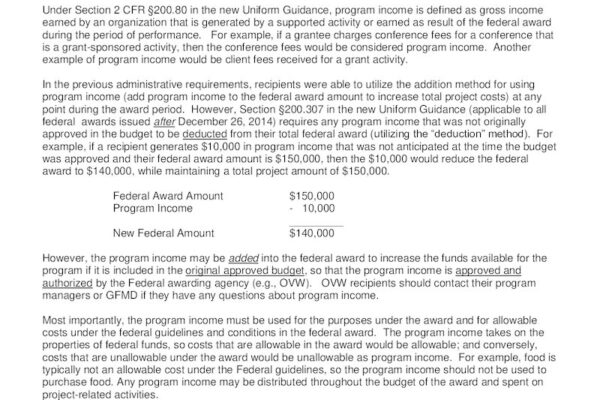
New Uniform Guidance: Fact Sheet on Program Income
These are fact sheets that summarize and provide an overview of the new administrative requirements from the New Uniform Guidance regarding Program Income and Subrecipient Monitoring (and Evaluation). The New Uniform Guidance (Section 2 CFR ?200) applies to all nonprofit organizations that receive federal grant funding awarded after December 26, 2014.
Non-Residential Domestic Violence Programs: Measuring Capacity to Serve Domestic Violence and Sexual Assault Survivors with Disabilities
This manual is designed to improve services for people with disabilities who have experienced domestic violence. It is our hope that domestic violence programs that have a strategic objective to serve people with disabilities will adopt the indicators presented in this guide. Domestic violence programs that measure their capacity to serve these survivors will know with greater certainty the impact of their efforts on the people they serve, and, ultimately, whether they are meeting the global mission of the domestic violence field to serve all survivors. To access the scoring tool for this manual please visit: http://www.endabusepwd.org/publications/indicators-scoring-tools/