
Recently Added
Battered Women’s Justice Project
Understanding The Difference Between a Domestic Violence Protection Order (DVPO) And an Extreme Risk Protection Order (ERPO)
“A domestic violence protection order (DVPO) is issued by a court to protect a survivor… Read more

Battered Women’s Justice Project
The New Misdemeanor Dating Violence Federal Firearms Prohibitor: An FAQ for Victim Advocates
This resource explains what changes the Bipartisan Safer Communities Act made to narrow the so-called… Read more

Battered Women’s Justice Project
State Statutes on Firearm Relinquishment in Cases Involving Intimate Partner Violence
“This chart includes information about state laws that speak to expressly authorized or mandated firearm… Read more

Battered Women’s Justice Project
Research at the Intersection of Intimate Partner Violence and Firearms
Prevalence rates of both intimate partner violence and gun violence remain pervasive. Research demonstrates a… Read more
Battered Women’s Justice Project
Promising Practices: Federal-State-Local Coordinated Justice System Responses to Domestic Violence and Firearms
“Over several months in 2024, the National Resource Center on Domestic Violence and Firearms (NRCDVF)… Read more

Battered Women’s Justice Project
Firearms Relinquishment in Cases Involving Intimate Partner Violence: How to Structure Effective Protocols For You Community
This resource details the importance of having a firearm relinquishment protocol and provides steps for… Read more
Inspire Action for Social Change
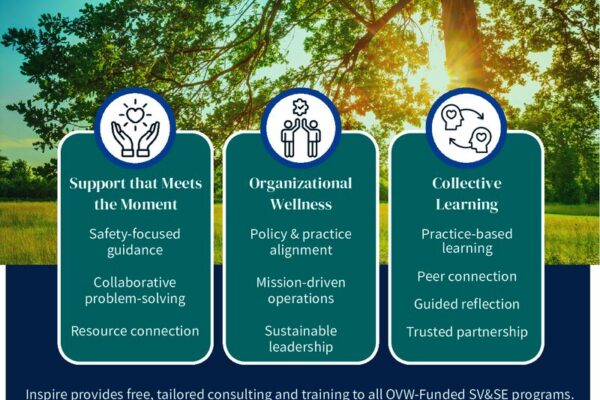
OVW JFF Informational Flier
This one-page document provides an overview of Inspire Action for Social Change’s technical assistance and training support for supervised visitation and safe exchange (SV&SE) programs. It describes Inspire’s focus on safety-centered guidance, organizational wellness, and practice-based learning, and summarizes the free, tailored support available to OVW-funded SV&SE programs.
National Clearinghouse on Abuse in Later Life (NCALL)
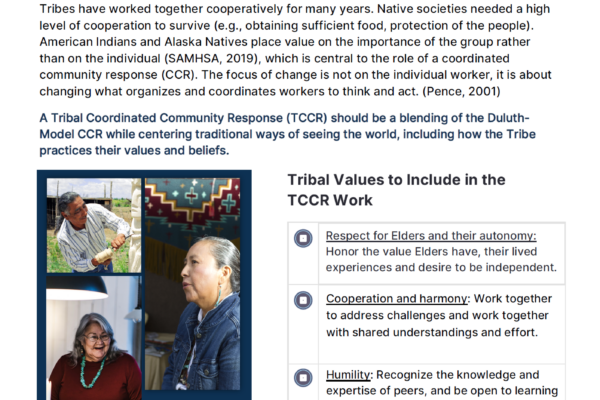
Elder Abuse within Tribal Communities: Tribal Coordinated Response
A resource created by Red Wind Consulting, Inc. with support from the National Clearinghouse on Abuse in Later Life.
National Clearinghouse on Abuse in Later Life (NCALL)
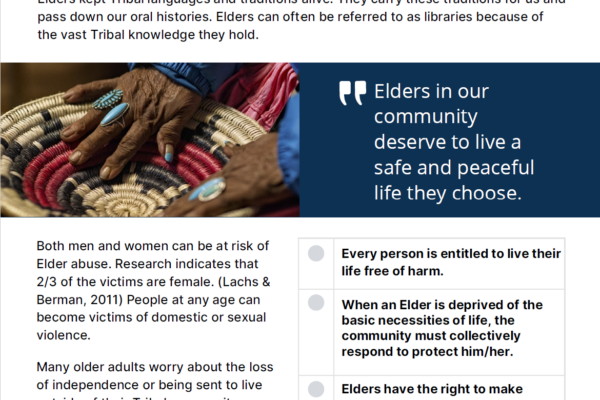
Elder Abuse within Tribal Communities: Understanding Abuse
A resource created by Red Wind Consulting, Inc. with support from the National Clearinghouse on Abuse in Later Life.
Guide to Conducting a Trauma-Informed Intake
Trauma-informed representation is grounded in a commitment to survivor safety, choice, collaboration, and empowerment, and is foundational for effective and ethical legal services. Accordingly, it is critical that organizations consider, plan, and implement trauma-informed principles even before a survivor has accessed services. This Guide is intended to help organizations think about and incorporate components of a trauma-informed intake.
Conducting Employee Surveys: A Tool for Trauma-Informed Legal Organizations
The “Conducting Employee Surveys” tool provides guidance for organizations administering employee surveys, whether for the first time or the hundredth.
Incorporating staff feedback into its practices is vital to an organization’s health. In order to feel empowered to provide meaningful feedback, staff must feel respected and have faith that the organization willl consider, and follow up on, their comments and suggestions. This tool offers advice for administering employee surveys in a trauma-informed, effective manner.
LGBTQ+ Inclusive Courtrooms: A Primer for Judges & Court Personnel
Judges and court personnel are in a unique position to build trust with LGBTQ+ communities and address some of the barriers LGBTQ+ survivors face to accessing justice. Building that trust can create an environment that is a meaningful option for LGBTQ+ survivors.
Judges and court personnel can take steps to ensure courtrooms and court processes are more accessible for LGBTQ+ litigants, thereby creating a safer forum for LGBTQ+ survivors to seek justice after experiencing domestic violence, sexual assault, and/or stalking.
Prosecutor Guide to Jury Selection in Cases with LGBTQ+ Victims of Domestic Violence, Sexual Assault, and Stalking
A prosecutor’s first opportunity to combat potential bias during a criminal trial is jury selection. Jury selection, also known as voir dire, provides an opportunity to address bias, correct misconceptions, and strive for fairness in the process. Jury selection is also an opportunity to educate the panel about the crime and parties, to obtain promises to follow instructions on the law, and to plant seeds about the concepts of fairness and justice in the context of the current case. For cases involving LGBTQ+ victims, a comprehensive voir dire strategy is key to ensuring that anti-LGBTQ+ bias does not determine the outcome of the trial.
This Guide is designed to support prosecutors in drafting jury selection questions and related motions in limine to help address anti-LGBTQ+ bias among potential jurors.
Prosecutor Guide to Best Practices in Cases with LGBTQ+ Victims of Domestic Violence, Sexual Violence, and Stalking
LGBTQ+ people experience intimate partner violence, sexual assault, and stalking at the same or higher rate as the general population. Transgender people and bisexual women are at particularly high risk of being victimized by these crimes. Despite these elevated risks, LGBTQ+ victims face major barriers to justice. Prosecutors should strive to ensure that LGBTQ+ survivors have equal access to justice throughout the criminal process, beginning by educating themselves in best practices in working with and supporting LGBTQ+ survivors in their cases.
This Guide provides introductory information and best practices for prosecutors working on cases involving LGBTQ+ victims of intimate partner violence, sexual assault, and stalking.
Standards of Practice for the Supervision of Domestic & Sexual Violence Attorneys
These Standards of Practice for the Supervision of Domestic & Sexual Violence Attorneys arise from a trend that the Commission has noticed in recent years: attorneys representing domestic and sexual violence victims often do not have adequate supervision. In response to this concern, the Commission convened a steering committee, comprised of twenty domestic and sexual violence attorneys from across the country. Developed and peer-reviewed by supervising attorneys, these Standards offer a best practice guideline for the successful supervision of domestic and sexual violence attorneys in both legal and non-legal settings.

Model Legal Services Agreement
The Model Legal Services Agreement (also known as a retainer agreement) is intended to serve as best practice guidelines for attorneys representing victims of gender-based violence, and helps set the framework for trauma-informed, client-centered representation. The model agreement and accompanying materials will help organizations reassess and update their existing legal services agreement, and serves as a valuable tool for organizations creating a legal services agreement for the first time.