
Recently Added
National Network to End Domestic Violence
Proveedores de Servicios a las Víctimas y Filtraciones de Datos: Consideraciones para el Desarrollo de Políticas Efectivas
Si se infringen los registros electrónicos y la información personalmente identificable se divulga fuera de… Read more
National Network to End Domestic Violence
Data Breaches & Victim Service Providers: Considerations for Developing Effective Policies
Many victim service providers now maintain electronic records that contain detailed personally identifying information (PII)… Read more
Inspire Action for Social Change
Program Guidance: Supporting Program Participants Experiencing Mental Health Distress in Supervised Visitation and Safe Exchange Programs – Including Expressions of Self-Harm or Harm to Others
This guidance helps SV&SE staff recognize and respond to participants’ mental health distress (including self-harm… Read more
Police Executive Research Forum
Tip Sheet: Ensuring Accountability in Officer-Involved Domestic Violence
Creating legitimacy and ensuring public trust begin with holding our own professionals accountable and enforcing… Read more
Police Executive Research Forum
Tip Sheet: Recognizing and Challenging Assumptions and Stereotypes
Every call involving domestic violence or sexual assault requires more than just a procedural response.… Read more
Police Executive Research Forum
5 Tips on Identifying the Predominant Aggressor in Domestic Violence Incidents
Law enforcement officers are often called upon to respond to domestic dispute calls in which… Read more
Stalking Prevention, Awareness, and Resource Center (SPARC)
Stalking Incident & Behavior Documentation Log for College Students
The stalking log should be used to record and document all stalking-related behavior. Recording this information will help to document the behavior for campus conduct or disciplinary hearings, Title IX investigations, protection order applications, or criminal prosecution. It can also help you remember individual incidents later, which you might need for reporting purposes.

Stalking Prevention, Awareness, and Resource Center (SPARC)
Stalking Incident & Behavior Documentation Log for College Students (Spanish)
The stalking log should be used to record and document all stalking-related behavior. Recording this information will help to document the behavior for campus conduct or disciplinary hearings, Title IX investigations, protection order applications, or criminal prosecution. It can also help you remember individual incidents later, which you might need for reporting purposes.

Stalking Prevention, Awareness, and Resource Center (SPARC)
Compilation of U.S. Laws & Statutes on Stalking, Harassment, and Related Offenses (current as of June 2023)
A compilation of statutes related to stalking, harassment, and related offenses for all U.S. jurisdictions (state, U.S. territory, District of Columbia, Federal, Military, and Native Nations). Current as of June 2023.
Stalking Prevention, Awareness, and Resource Center (SPARC)
Workshop: Stalking on Campus – Facilitator guide
This workshop is intended for a broad campus audience, from students to faculty and staff. It can be facilitated at new student orientations as well as for smaller groups on campuses (such as fraternities/sororities, gender center programming, or religious organizations). While we suggest that the facilitator(s) be familiar the dynamics of power-based violence, the program is fully scripted, activity-based, and should be simple to implement for anyone who wishes to do so. This introductory session provides a basic overview of stalking, focusing on defining stalking, identifying stalker behaviors, and recognizing the prevalence and dynamics of this often misunderstood form of abuse. Participants will also leave the session with guidance and information on how to support victims and connect them with resources.
Stalking Prevention, Awareness, and Resource Center (SPARC)
Stalking on Campus Public Awareness Workshop Slideshow
A slideshow for a public awareness workshop on the prevalence of stalking on college campuses and among college-age adults (ages 18 to 24).
Stalking Prevention, Awareness, and Resource Center (SPARC)
Stalking on Campus Public Awareness Workshop Slideshow (accessible)
An accessible (text-only) version of a slideshow for a public awareness workshop on the prevalence of stalking on college campuses and among college-age adults (ages 18 to 24).
Stalking Prevention, Awareness, and Resource Center (SPARC)
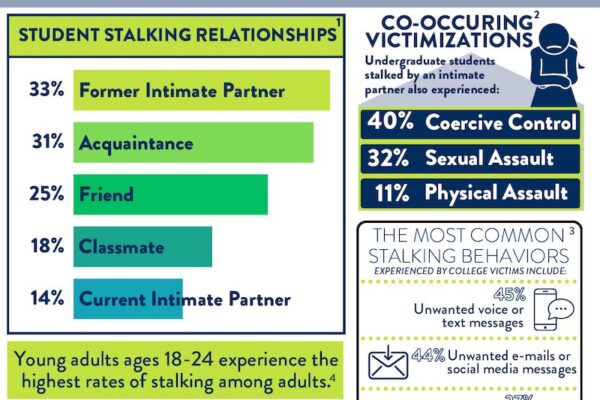
Infographic: Stalking & the College Campus
An infographic on the prevalence of stalking on college campuses and among college-age adults (ages 18 to 24).
Stalking Prevention, Awareness, and Resource Center (SPARC)
Workshop: Stalking: Know It, Name It, Stop It – Facilitator guide
This workshop is intended for a broad audience and can be offered in a variety of settings including (but not limited to) PTA meetings, office lunch-and-learns, congregational meetings, or anywhere that people gather. While we suggest that the facilitator(s) be familiar with the dynamics of power-based violence – for example, an educator from your local domestic violence agency – the program is fully scripted, activity-based, and should be simple to implement for anyone who wishes to do so. This introductory session provides a basic overview of stalking, focusing on defining stalking, recognizing the contextual nature of this crime, and providing strategies for participants to get involved in building awareness and supporting victims and survivors.
Stalking Prevention, Awareness, and Resource Center (SPARC)
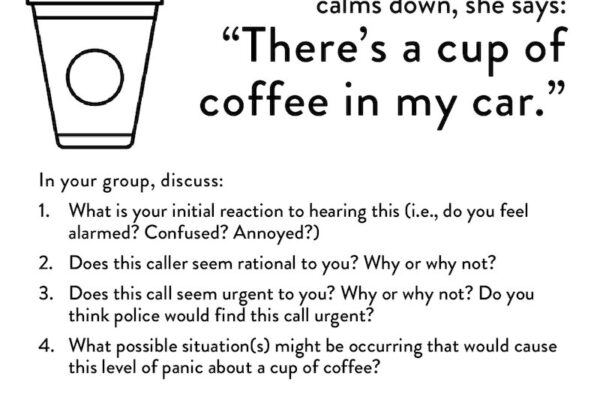
Workshop: Stalking: Know It, Name It, Stop It – Handouts
Handouts for a public awareness workshop on stalking that include stalking scenarios, brainstorm activities, victim stories, and tips and resources for supporting loved ones experiencing stalking.
Stalking Prevention, Awareness, and Resource Center (SPARC)
Workshop: Stalking: Know It, Name It, Stop It – PowerPoint slides
A slideshow for a public awareness workshop on stalking