
Recently Added
Attorney Safety Guide
Attorneys who work on cases involving domestic and dating violence, sexual assault, and stalking (DVSAS)… Read more
Battered Women’s Justice Project
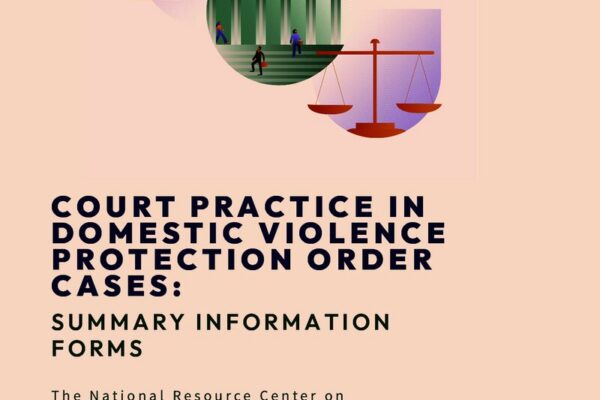
Court Practice in Domestic Violence Protection Order Cases: Creating Court Summary Information Forms
Because protection orders can be the basis by which someone is ineligible to receive a… Read more

Battered Women’s Justice Project
Court Practice in Misdemeanor Crimes of Domestic and Dating Violence Cases: Creating Court Summary Information Forms
Because misdemeanor convictions for crimes of domestic and dating violence can be the basis by… Read more
Battered Women’s Justice Project
U.S. v. Rahimi: Understanding the Implications for Protection Orders and Firearms Prohibitions
In June 2024, the U.S. Supreme Court upheld the federal law that prohibits domestic abusers… Read more

Battered Women’s Justice Project
What High Schools and Colleges Need to Know About Dating Violence and Firearms
In the United States, one in eight high school students reports having been subjected to… Read more

National Council of Juvenile and Family Court Judges
Building Sustainable Relationships with Schools to Improve Intervention and Response to Dating Abuse: A Toolkit for OVW Rural Grantees
This toolkit is a collection of resources and strategies to assist OVW Rural Grantees in developing sustainable relationships with schools. The first section examines the context of rural dating abuse […]

Canva Infographic Tutorial
Follow the steps in this tutorial to create an infographic from your program progress reports.
Child Support and Domestic Violence: A Guide for Courts
Domestic violence survivors often struggle with financial stability and providing for their children post separation. In fact, economic instability is a driving factor in why many survivors return to abusive relationships. While survivors may be entitled to access child support, it is often a confusing process that can put them at risk for further abuse. This guide outlines how courts can work with child support agencies to provide survivors with the support they need to make informed, voluntary decisions about whether to pursue child support, and to make the process safe and effective for those survivors who choose to pursue it.

Child Support and Domestic Violence: Tips for Supervised Visitation Centers
Programs providing supervised visitation and/or safe exchange services have been increasingly collaborating with the court and legal systems to provide a more holistic response to domestic violence cases. This fact sheet provides some tips for supervised visitation programs to help support survivors navigating the child support process.
National Council of Juvenile and Family Court Judges
Civil Protection Order: Case Law Update 2019
This document contains summaries of published state court decisions of interest related to civil protection orders, their issuance, and their enforcement for the year 2019. While most of these summaries are brief, containing only the courts holding and any necessary background or procedural details, a few have been expanded based on their complexity, their uniqueness, or the importance of their holding.

National Council of Juvenile and Family Court Judges
Civil Protection Orders: Strategies for Safe and Effective Service of Process
For civil protection orders to be effective, they must first be served on the respondent. While most states require that protection orders be personally served on the respondent, this can often prove to be a difficult task to accomplish. This publication includes strategies and resources for effectuating service of process in a safe and effective manner as well as a preliminary look at the use of electronic service of process in the civil protection order system.
National Network to End Domestic Violence
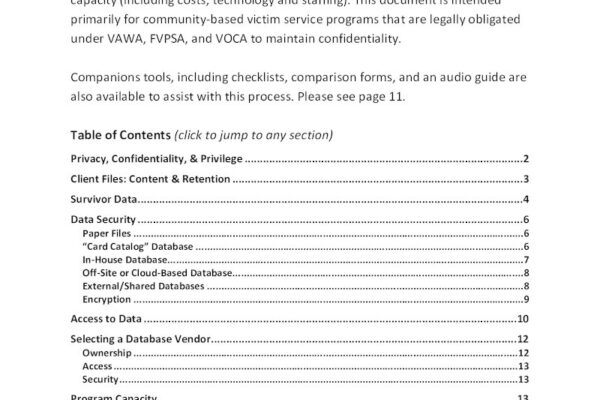
Client Information Databases and Confidentiality: A comprehensive guide for service providers
This document is both an overview of key data and confidentiality concepts, and a guide to the many considerations that must be weighed when selecting a database, which include: purpose, confidentiality, data security, and program capacity (including costs, technology and staffing). This document is intended primarily for community-based victim service programs that are legally obligated under VAWA, FVPSA, and VOCA to maintain confidentiality.

Alliance for HOPE International
Client Services Toolkit
Created by the Alliance, and updated in September 2019, this toolkit is designed to assist Family Justice and Multi-Agency Centers with providing client services and managing client flow throughout the Center. This toolkit provides suggestions and serves as an outline and reference for developing and implementing a centralized client services processes within a Center. The toolkit includes sample protocols for client intake, assessment, and service delivery.
Battered Women’s Justice Project
Collaborating for Safety: Coordinating the Military and Civilian Response to Domestic Violence – Elements and Tools
This document sets service-wide domestic abuse policies and defines the roles and responsibilities of commanders and first responders. It provides a useful benchmark as you learn about the installation in your community and its response to domestic abuse. If you are a military victim advocate or otherwise affiliated with the installation, you can use it to review roles and protocols and expectations around coordinated community response.
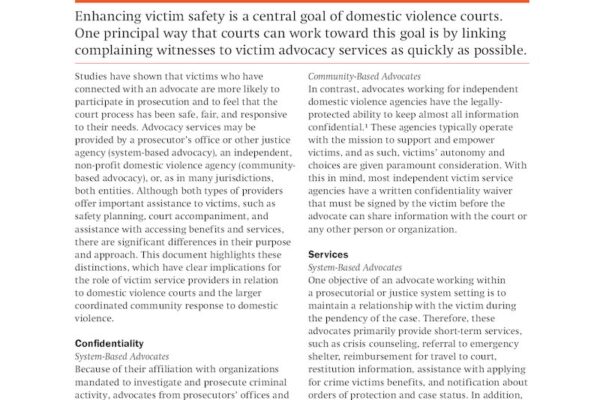
Collaborating with Victim Service Agencies
This fact sheet is meant to aid domestic violence court planners and practitioners in collaborating with system-based and community-based victim advocacy services.